Willingness to pay
- Willingness to pay is the highest value a consumer will pay for a product
- Generally its best to compute willingness to pay relative to your main competitor, but you may often have too many to benchmark or none at all
- marginal willingness to pay (MWTP): the amount customers are willing to pay for a particular feature of your product relative to a specified baseline (i.e. how much your customers are willing to pay for an upgrade from feature A to feature B, in addition to the price they are already paying).
- Note willingness to pay changes over time and varies from person to person.
How is it measured?
- Gabor-Granger: elasticity modelling. good for when you have a reasonable range of prices and want the revenue maximising one.
- Van Westendorp: Identifies each respondents' "too cheap","cheap","expensive", and "too expensive" price levels to determine acceptable price range. Goood when you don't have a good idea on the range of prices to consider
- Conjoint Analysis: for marginal WTP
- Revealed preference modelling (name mine): rarer, but uses previouus data to extrapolate to what they would pay for an product they've never seen
Gabor-Granger
Read more here: https://conjointly.com/products/gabor-granger/
Basically Price elasticity modelling:
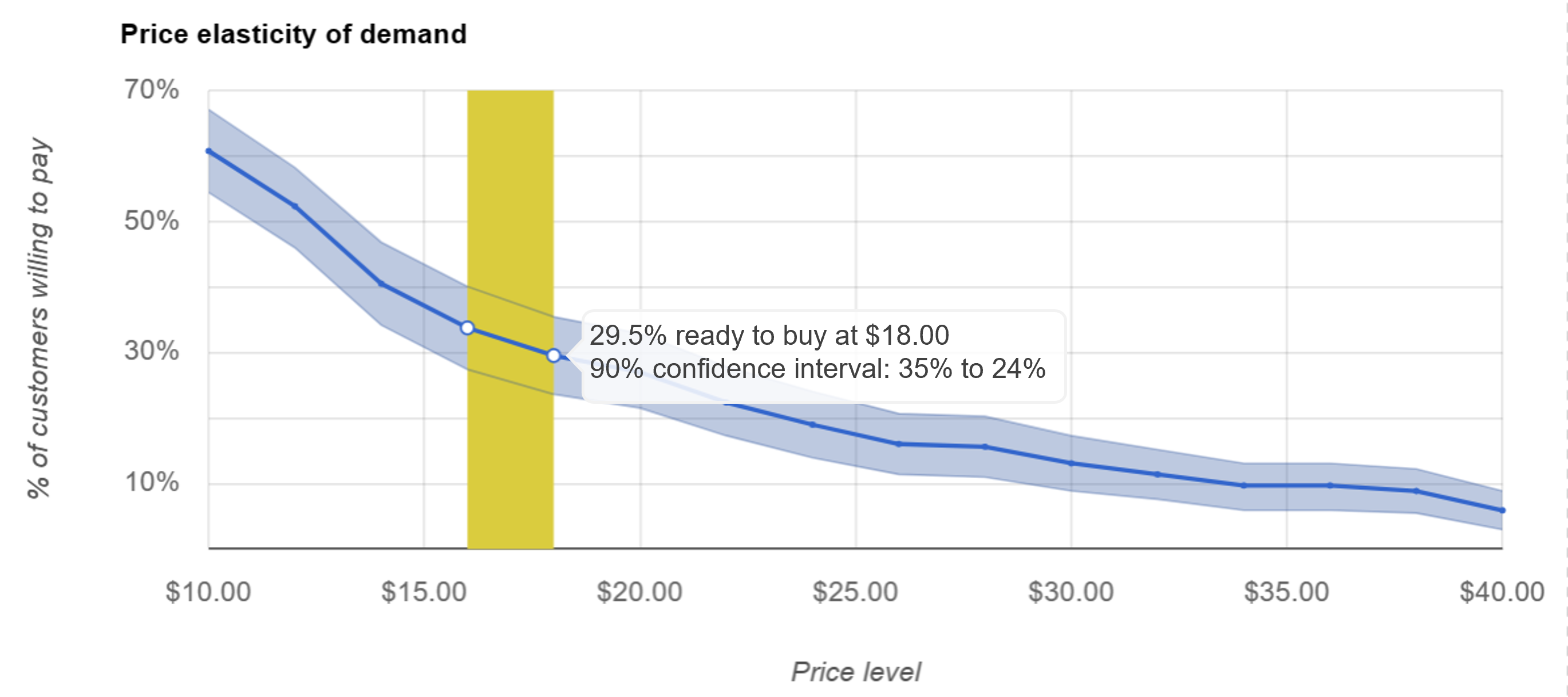
You can ask them multiple "would you buy this for $XX?". I'd probably add in random product attributes or descriptions. Or just ask each participant once or twice.
Some articles advocate asking multiple times the same person then getting a highest WTP, the plotting that. I am sceptical of this.
I'd get a few yes/no questions answers, then fit a logstic regression to get the curve, then multiply out each price point with the probability to optimize the price.
Van Westendorp’s Price Sensitivity Meter
Van Westendorp’s Price Sensitivity Meter is used to build a range of acceptable prices for a given item with the following questions:
- At what price would you consider {product} to be so expensive that you would not consider buying it? This gives you Too expensive
- At what price would you begin to think {product} is getting expensive, but you still might consider buying it? This gives you Expensive
- At what price would you begin to think the product is so cheap that you would feel the quality couldn't be very good and not consider it? This gives you Too cheap
- At what price would you think the product is a bargain – a great buy for the money? This gives you Cheap
Note: show all 4 questions on the same page to get participants to consider them all together.
Then you can plot them all:
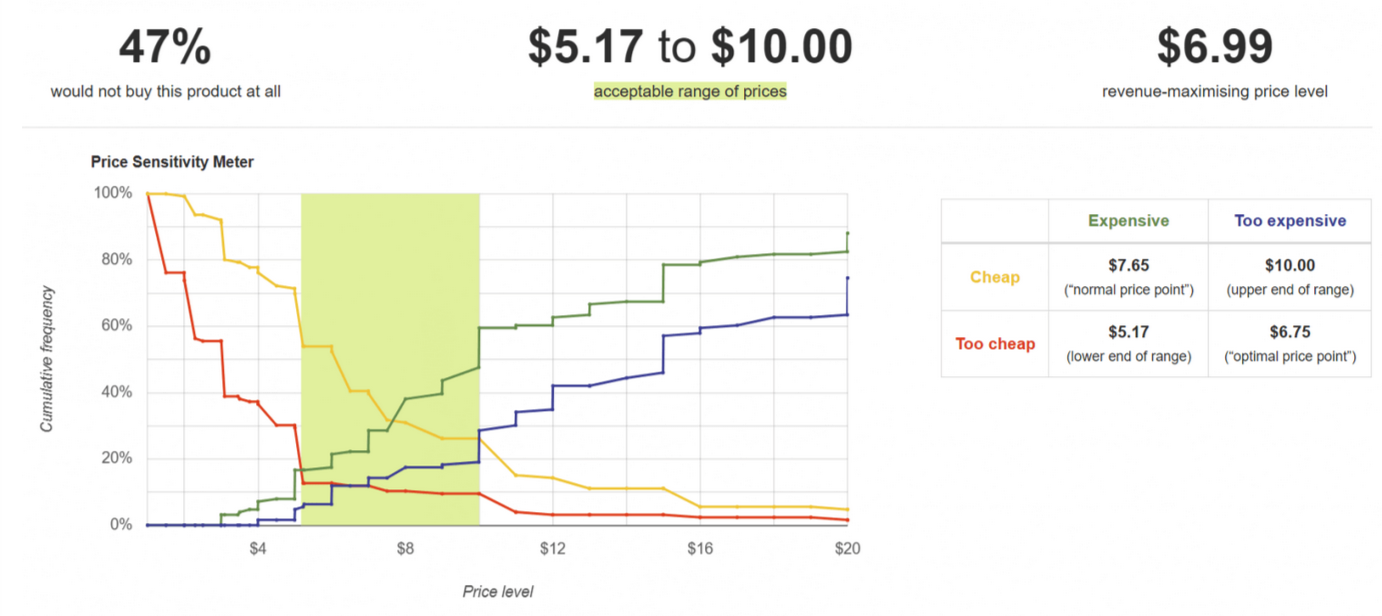
- The lower bound for this product is where too cheap and expensive intersect.
- At prices below this, more consumers think its too cheap than think its expensive
- The upper bound is where too expensive and cheap intersect.
- Price higher than this, more consumers think its too expensive than think its cheap
- The optimal price might be the intersection of too expensive and too cheap
You can find the price for which the most people
Conjoint analysis
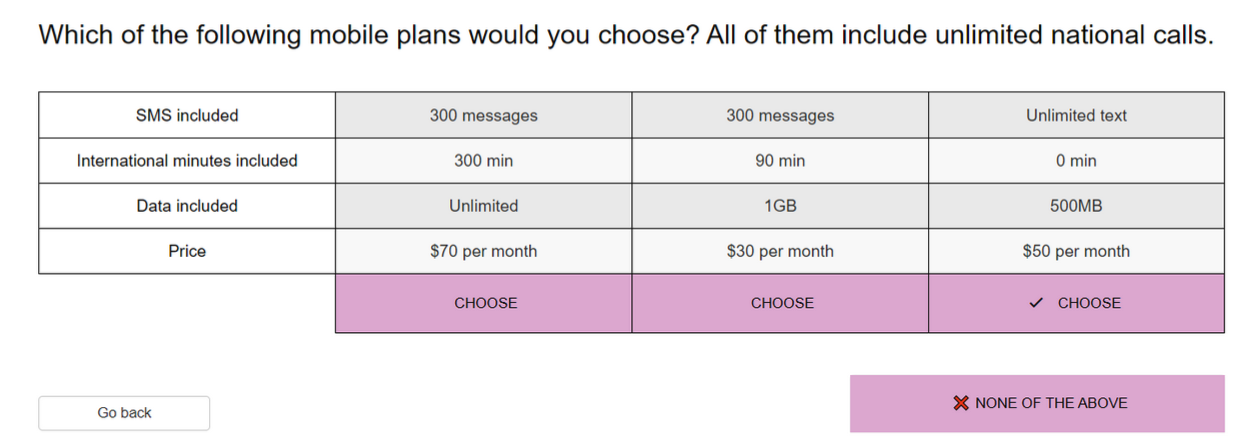
- Price points should range from ~60% to 140% of the realistic price.
- Include up to 7 attributes
- Conjointly argues that 10-14 questions is sufficient
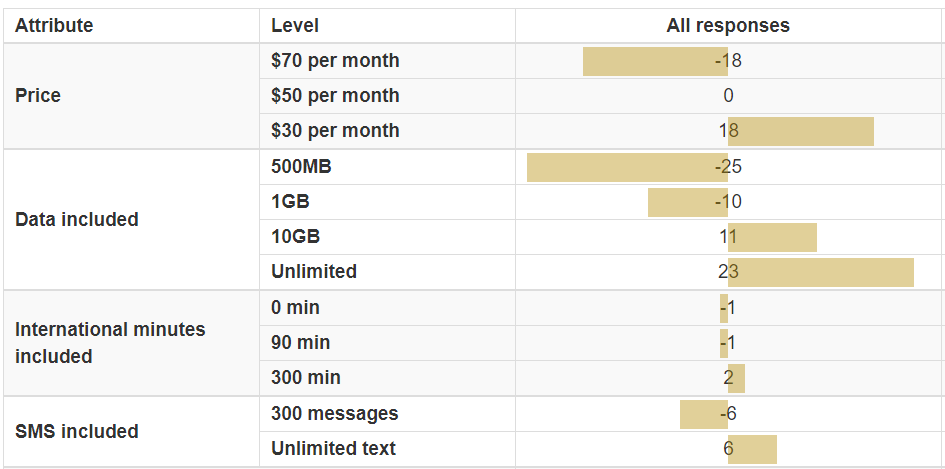
Preference scores are used to build simulators that forecast market shares for a set of different products offered to the market.
Revealed preference modelling
- This is called many things in the literature but basically its building a model of what consumers paid predicted by the features of a product, then you can use that model to predict what they'd pay for a hypohetical ew product by inputting its hypothetical features.
- I wonder if you can use quantile methods to get a range of willingness to pay?