UK farmland use
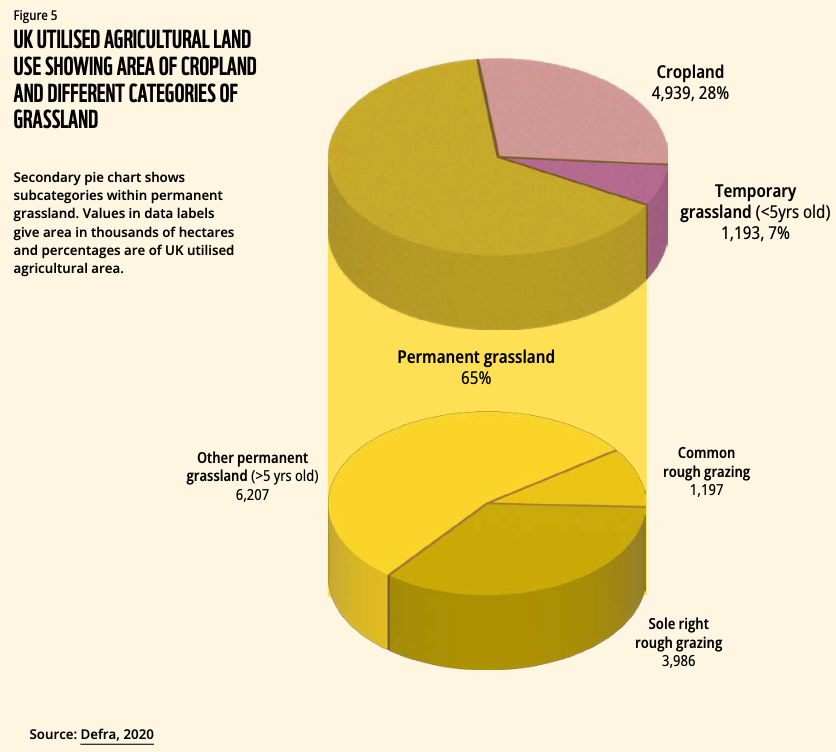
WWF, 2022: The vast majority of agricultural grasslands in the UK are used for animal production, either for grazing or to produce hay and silage for fodder.
Around 90% of UK grasslands are classed as permanent grassland - areas of land which have been used to grow grasses and other herbaceous crops for at least 5 consecutive years.
which are less than 5 years old and commonly grown as part of a crop rotation - covered around 7% of the UK UAA in 2019 (1.2m hectares).
Most grassland (95%) is classed as ‘improved’ or ‘semi-improved, 57 meaning that it has received fertilisers, or undergone soil mobilisation and sowing of selected varieties, which can be used for more intensive grazing and production of hay and silage.
Rough grazing land makes up 46% of the UK’s permanent grassland. This refers to areas which usually have poor soils and lower productivity and support only extensive - low density - grazing, particularly of sheep. These include areas of mountains, hill, heathland and moorland. Much of this is officially categorised under Less Favoured Area (LFA) status - land that is considered of marginal economic value when the value of output is compared to the cost of the inputs.
These areas are substantial, with 80-90% of land in Wales and Scotland classed as LFA. And in England, almost a third of beef cattle (27%) and 40% of female breeding sheep are produced on LFA grazing livestock farms.