The small body problem
- Most fishing is unsustainable
- The Small Body Problem Challenges and Considerations for Animal Advocates
- Solutions to the small body problem (Insight piece)
- The small body problem might be a positive sign
What is the small body problem?
The small body problem occurs when we convince people to shift their diet from red meat to fish and poultry (and occasionally, insects). Though this reduces GHG emissions and probably makes them healthier, it results in far more animals dying. This is because fish and chickens have small bodies and as such provide relatively little meat per animal killed. A cow can feed a village, whereas a single bucket of chicken wings is a lot of dead chickens. As such, while the shift is positive from a health and environment point of view, it could be disastrous from an animal suffering point of view.
Fish, chicken and eggs are not that bad for the environment and are may not that bad for your health. This raises the uncomfortable conclusion that, if you don't care about animal suffering, most health and environmental effects of animal agriculture could be offset by a move from beef and pork to chicken and fish. Unfortunately, this is also likely to be an easier change to make than going plant-based. As such we need to have arguments ready to respond to this.
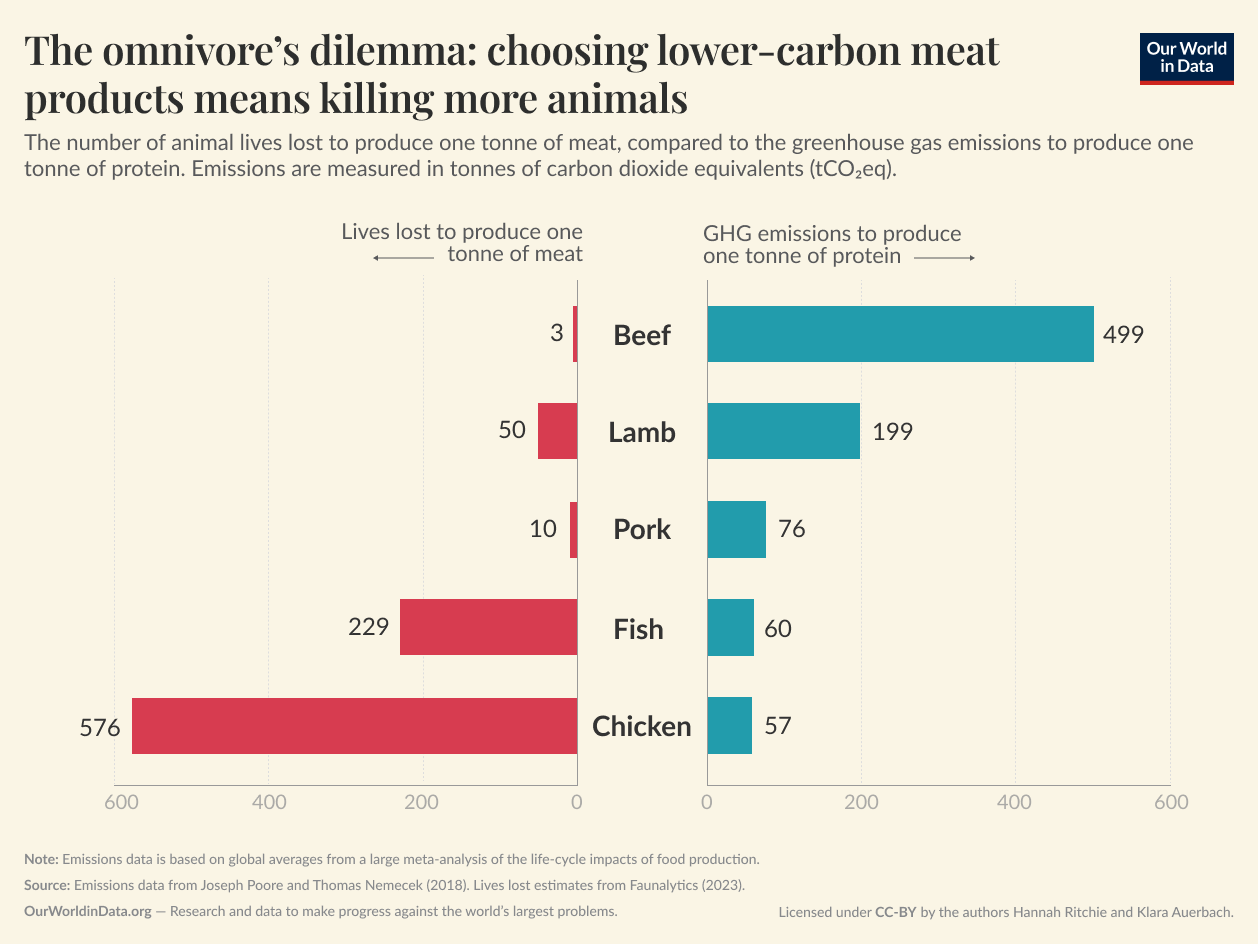
From OWID
To make it even worse: higher welfare pork and free range chicken has a worse environmental impact!
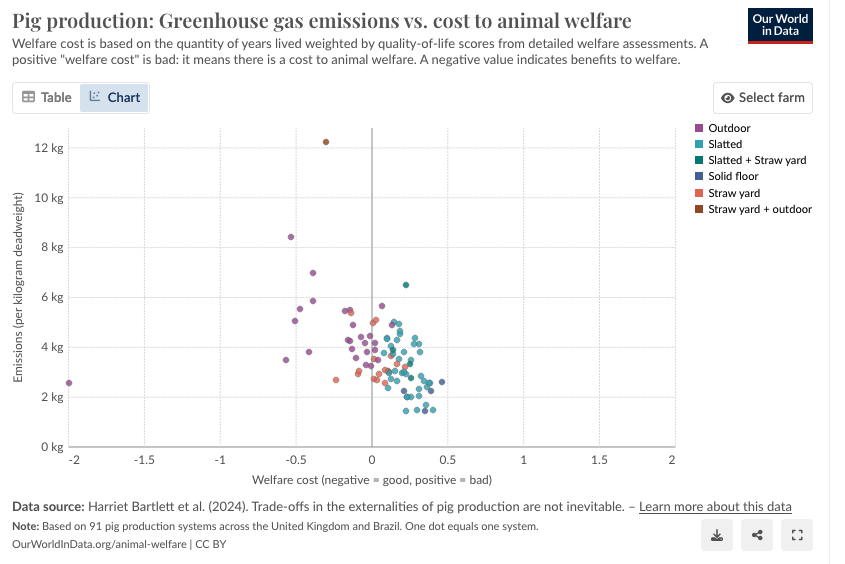
- The difficulty with the small body problem is that health, environment and animal welfare are all far less convincing/effective when it comes to chicken and fish
- Chicken and seafood, not being mammals, are harder for consumers to intuitively empathise with. Fish and crustaceans especially; most people think they're weird, not cute.
- Also, giving up beef, mutton and dairy would reduce agricultural land by 73.4%, going entirely vegan reduces it by 75.8%
This is already happening
- Truman et al., 2023 found that while hospital patients did not care about eating red meat in hospital they overwhelmingly preferred it to be replaced by chicken or fish
- (Stewart et al., 2021) over time shows decreasing UK red and processed meat consumption and increasing white meat consumption
- Poultry is the fastest rising meat produces worldwide (Ritchie et al., 2017)
- Polling from Bryant shows people correctly realise that chicken is lower env footprint and healthier
- When Denmark’s Aarhus municipality tested a carbon tax on cow, sheep and pig farming in 2022, beef purchases dropped by 40% while demand for chicken and pork increased.
- Argentinians are responding to increasing costs for beef by swapping to chicken.
Solutions
Reframing the debate
We need to reframe the debate to "If you care about animal suffering, the environment and health, there is no solution that ticks all the boxes except vegan"
Health
no meat is healthier than chicken and fish
- While people who eat only fish are healthier than people who eat other meats, vegetarians who eliminate all meat and fish are even healthier. They have a lower cancer risk
- Plant based foods have a good amount of fibre, unlike chicken or fish which have none
- Scarborough et al., 2012 found that swapping 50% of pork and chicken to plants prevented 8.5x more deaths than swapping 75% of Beef for pork and chicken.
- Guasch-Ferré et al., (2019) found that only a plant based diet produced better heart health compared to beef: all other diets including animal products did not do better than beef.
Negative health effects of chicken eggs and fish
- Maki et al., 2012 A review of 8 studies (beef industry funded btw) suggests "beef no worse for your heart than chicken or fish"...which also means chicken and fish are not hugely better than beef!
- Also found in Guasch-Ferré et al., (2019) reviewed 36 RCTs with 1800 participants, every study up to 2017. They found that red meat diets only did worse on signals of CVD when compared to diets rich in plant protein sources. When compared to other diets it did not fare much worse: chicken/poultry/fish; fish only; poultry only; mixed animal protein sources (including dairy); carbohydrates (low-quality refined grains and simple sugars, such as white bread, pasta, rice, cookies/biscuits); or usual diet.
Chicken
- This study suggests that chicken products available in the european market contain significant levels of 33 cancer-causing chemicals, including pesticides and polycyclic aromatic hydrocarbons (PAHs) from smoked foods. These chemicals get into the meat through the environment. They suggest the the optimal amount of meat including chicken is 5 portions a month.
- Evidence suggest slightly higher diabetes risk from eggs Schwingshackl et al., 2017b
- health effects of chicken
Fish
- Jakobsen et al., 2011 found that eating more fish did not prevent weight gain
- Telling people about the risks of fish consumption reduces intentions to eat fish
Disease
- This study argues that replacing beef with chicken increases zoonosis risk.
Environment
- Willits-Smith et al., 2020 finds that whilst switching from beef to chicken does reduce GHG, going veggie even more.
- For the #High_Income_Countries/UK we can focus on pollution of rivers
- Deforestation: Ritchie, 2021
Alt proteins as the solution
- alt proteins might be the best solution here. Some of the key issues with alt proteins are taste and cost.
- But seafood is already expensive, so PB seafood has a lower cost bar to clear.
- PB chicken alternatives have recently started to beat actual chicken in taste tests.
Counter arguments
- Alt proteins will struggle to become cost competitive with chicken
- Alt proteins may find it hard to replicate the taste of some fish
- Not all alt proteins are healthy, some are nearly as bad as the meat they replace.
Misc arguments
- We eat too many animal products including fish and chicken
- Pais et al., 2020 found that reducing non-fish meat consumption would harm economic growth, but this growth could be mostly offset by increasing plant consumption. However increasing fish consumption would not make up for GDP losses due to less meat.