Subsidies
Reading
- Key FAO 2021 report about global subisides https://www.fao.org/documents/card/en/c/cb6562en
- Interesting EU report on CAP subsidies: https://cor.europa.eu/en/engage/studies/Documents/CAP-developing-countries.pdf
How much would meat prices rise with no subsidies?
- National farmers union estimates that phasing out EU agricultural subsidies could reduce farmers income by 60-80% by 2024
- Given that meat producers gain most subsidies, they't be most affected, so let's take the upper bound of 80%.
- Assume that farmers are totally unable to absorb the loss in income, so they increase prices by 80% to supermarkets. If they accept lower income prices would rise by less, but farming is extremely low margin so they likely aren't able to absorb much
- Assume the same with supermarkets, which are also low margin businesses.
- This means a price increase to consumers of up to 80%
What I don't get about subsidies
- Why are subisidies paid to farmers who then export? Are they?
Using subsidies for animals not against them
- Springlea, 2022 Animal Ask evaluate subsidy reform
- Bhattacharya, Bryant and Couture 2023
EU subsidies
- Documented here: https://farmsubsidy.org/
- Feeding the problem (Greenpeace, 2019) document the subsidies attached to livestock
- A recent Nature paper by Kortleve et al., (2024) found that 82% of EU CAP subsidies goes towards animal agriculture, 38% directly and 44% for animal feed.
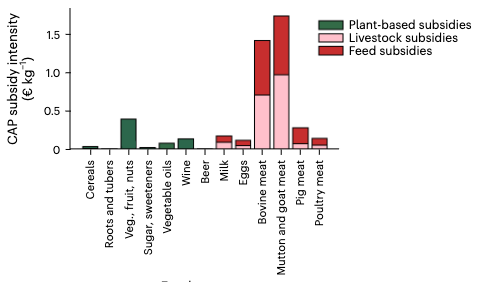
From kortleve et al., 2024
EU subsidies end up in exports (kortleve)
In 2013, the total CAP budget was €57 billion, of which 84% supported food for consumption by households, 1.5% was lost through agricultural losses and 14.5% supported other uses such as biofuels or fibres. We find that 63% of CAP subsidies were domestically consumed, 23% were traded within the European Union and 12%, or €6.8 billion, was exported to non-EU countries (Fig. 1a). The large majority, 75%, of these non-EU exports were destined for upper-middle and high-income
countries, including China, Russia and the United States. As such, 12% of CAP subsidies do not support food security within the European Union, a key goal of the CAP (Fig. 1b), leading to distorted situations where China consumes more embodied CAP subsidy than the Netherlands (17% of total embodied subsidies in non-EU exports) or the United States more than Denmark (9%;
Subsidies worldwide
Springmann and Freund, 2022 detail 20% of subsidies go towards meat, 10% towards dairy, less than 25% towards healthy environmentally friendly foods.