Most people strongly support animal rights
Approximately three-quarters of respondents to a 2018 survey conducted for the National Chicken Council said they were concerned about how chickens are raised for meat.[1]
- Canadians Support An End to Cage Confinement for Egg-Laying Hens
- Acceptability of Farming Practices
- In UK Consumer Attitudes Towards the Egg Industry Bryant showed the most UK consumers are unaware of male chick culling and oppose it, and have strong support for in ovo sexing
- Bhattacharya, Bryant and Couture 2023#The public supports higher standards
- A study of 14 countries around the world (unread) suggested that most people support better animal welfare[2] non random sample, not enough to represent the population.
- n a 2018 Faunalytics survey, 62-79% of Americans, Brazilians, Indians, and Russians agreed “that animals used for food have approximately the same ability to feel pain and discomfort as humans.” (Fewer Chinese agreed, but in a 2021 survey, more than 80% said it was somewhat or very important that mammals and birds are well cared for.)
- In a recent survey by Michelle Sinclair and colleagues, over 75% of respondents in 14 diverse nations agreed that the welfare of farm animals “is important to me” — a similar share to those who said so for companion animals.
- A 2019 Faunalytics survey found that most Americans agreed that “people have an obligation to avoid harming all animals,”
- a 2015 Gallup survey found that fully a third of Americans believe animals deserve “the exact same rights as people to be free from harm and exploitation.”
Most people underestimate support for animal welfare
- Anderson and Tyler, 2018 is the only study on this I could find but suggested that across the US and BRIC countries, most people think the average citizen of their country is less supportive of animal welfare than they are.
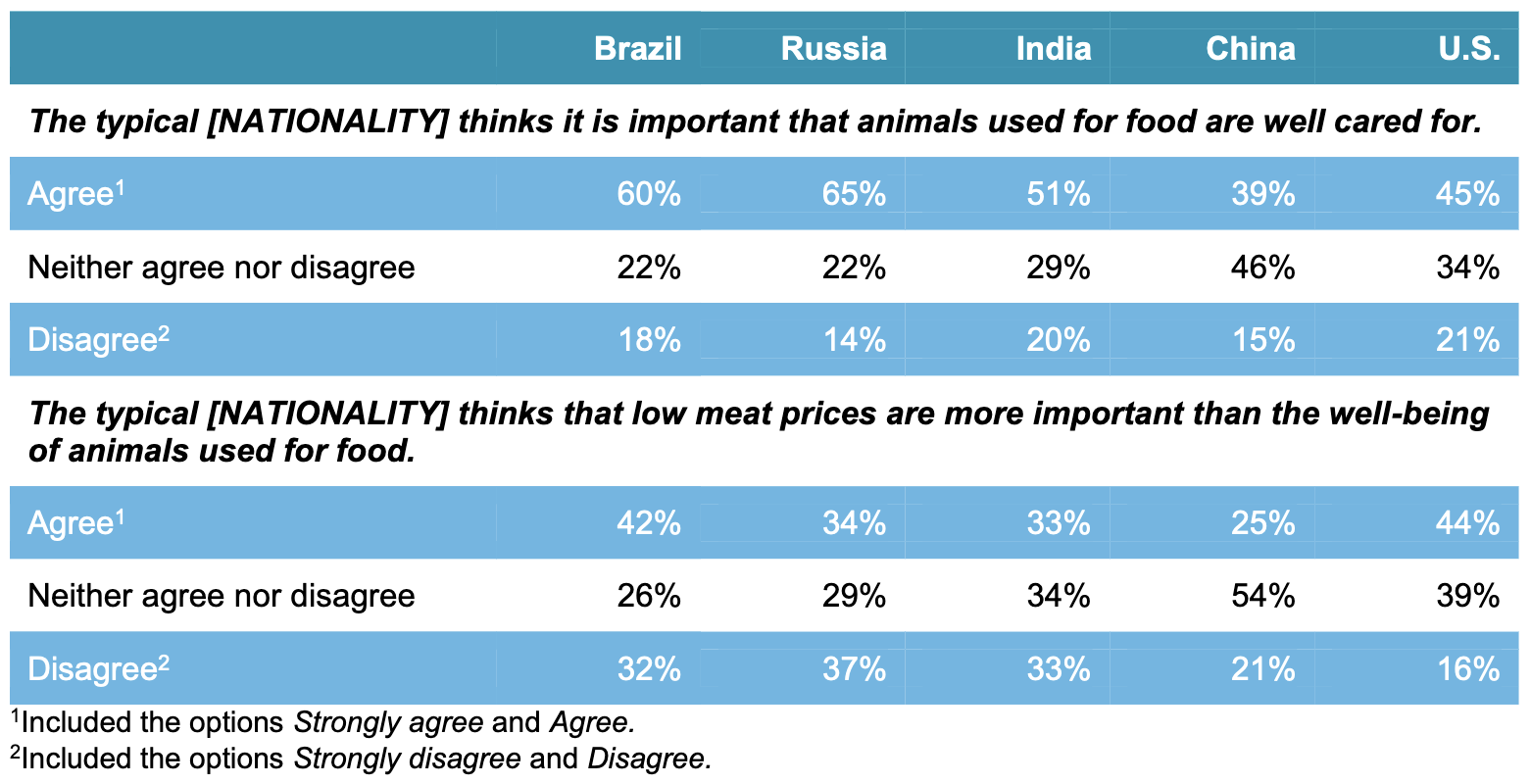
This is also found in environmental studies.
Critique
It may be that when asked about their attitudes they lie or present themselves overly positively but when asked about other's they give an honest opinion. This is an important distinction.
psychologists have also found that many people may hold the same attitude
while simultaneously believing everyone else holds a different attitude, because no one talks
about their privately held beliefs (a phenomenon known as pluralistic ignorance; Prentice & Miller,
1996). People tend to avoid talking about the welfare of farmed animals, so many individuals may
privately hold more pro-animal beliefs than is apparent from their behavior.
# References
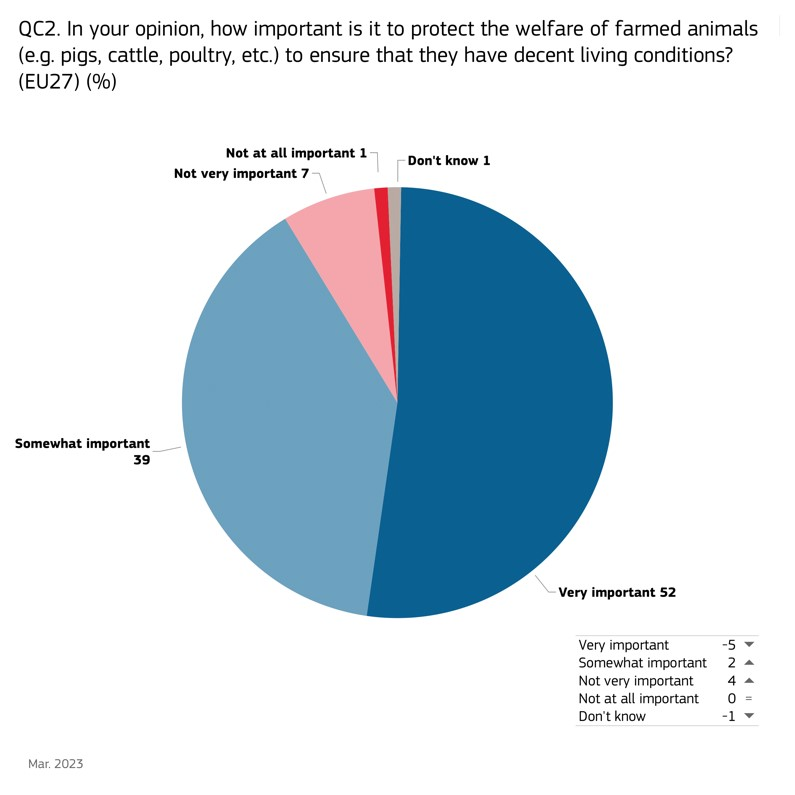
Most Europeans support high welfare
https://europa.eu/eurobarometer/surveys/detail/2996
Read the rest of the article and extract info, possible also get the raw data
84% of Europeans believe that the welfare of farmed animals should be better protected in their country than it is now. A similar number (83%) support limiting the transport time of animals. Almost three quarters of respondents (74%) support better protection of the welfare of pet animals in their country and 90% of Europeans consider that farming and breeding practices should meet basic ethical requirements.