Meat free Mondays
“Meat Free Monday” has been encouraging people to have at least one meat-free day per week since 2009 (www.meatfreemondays.com).
There are 2 things here:
- Personal decisions to go meat free on mondays
- Institutions going meat free
Every other year the Meatless Monday org commissions the Data Decisions Group to do a survey.
Awareness
MFMs November 2021 study (1010 amerericans, representative) found that 50% were planning to participate in mfm in 2022. It has some other stuff but I here I only report the bits directly relevant to mfm. 38% awareness in 2021, 20% participated. Of those aware, 41% said that campaign influenced their decision to reduce meat. Awareness is highest among active meat reducers (49 percent) and those who have cut back in the past (42 percent). The primary sources that people heard about Meatless Monday were through social media (40 percent) and friends and family (28 percent). Of those influenced by Meatless Monday, 40 percent reportedly ate more fruits and vegetables, 29 percent eat less meat, 26 percent have tried to incorporate more meatless meals throughout the week, 25 percent have experimented with new meatless recipes when cooking at home, 20 percent have tried more meatless dishes when eating out. It's not clear what "influencing actually means here"
- Race difference: over 25% of African Americans said that they planned to do Meatless Monday every week in 2022, which is significantly higher than the 17% of White Americans planning to participate every week.
Support
- Ewens et al., 2023 Found in a sample of<200 hospital staff that 59% were positive of mfm
Faunalytics have a dashboard that allows you to explore the characteristics about who supports or doesn't support meatless mondays in schools:
- Attitudes did not differ by age, race, income, whether they were a student or not, US region, whether they have a companion animal, in relationship or single, whether someone was the households primary shopper,
- Women (68%) were more supportive than men (51%).
- More education meant higher support (no college 55%, undergrad 61%, PhD 66%)
- Small urban rural divide (55% compare to 60%)
- Political beliefs was the biggest: 39% cons, 50% moderates, 72% libs
- congressiona leaning was not nearly as large (solid republican 56%, solid democrat 63%)
- Much higher (63%) among health conscious than not (49%)
- Much higher among those concerned by climate change (66%) than not (27%)
- strong difference between animal lovers (62%) and non (46%)
- Encouragingly support was higher (63%) than those unlikely to vote (47%)
Effectiveness
Indirect evidence of the suggest of meat free Mondays might come from Vonderschmidt et al., 2023 who found that 1/3 of the meat reduction in the UK in the last 10 years has come from an uptick in meat-free days.
A 2017 report by Mintel found that the top reason US consumers use meat alternatives is because they occasionally like to have meat-free days (31 percent)
When the Norwegian military tried to introduce Meatless Monday's in 2013 it met a lot of resistance and only ended up being implemented in 7 of 20 kitchens[1]. Interviews suggested that it as the initiative of a few nutritionists high up in the military and that not enough effort was taken to convince chefs and cooks of the environmental and health benefits of reducing meat. Cooks did not recieve training and were not involved in the decision. A survey form ~1300 soldiers revealed that soldiers in whose kitchen reduced meat reported marginally (non sig) more positive attitudes towards vegetarian food, but no higher likelihood to eat veg when they left the military. Basically it was a total failure.
Doing it on Monday is a good idea because people are more likely to contemplate healthier choices at the start of the week (here and here both unread)
Research idea: replicate this[2] but for meat free Mondays or Veganuary #Bryant/Project/Idea
Another idea: Environmental impact of meat free Mondays compared to eating local.
Lombardini & Lankoski (2013) discusses a mandatory Meat free Monday implemented in Helsinki schools
A 2017 review of Meatless Monday campaigns at twelve Bon Appetit Management Company sites located mostly on college campuses outlined some of the lessons learned from such campaigns (Chan & Ramsey, 2017). When programs forced everyone to go meat free, there was pushback, especially from student athletes, but were more successful when some dining outlets offered meat and others were meatfree. However, the most successful college Meatless Monday initiatives were those that responded to this student feedback and altered the program design. They did so by partnering with student groups on education and communication around Meatless Monday. Additionally, creating flavorful and interesting vegetarian dishes assisted in program acceptance among participants. What do they even mean by success here? read the paper and see if it actually decreased meat consumption
Best practices for implementing MFM campaigns
This study looks at 7 mfm campaigns across the US and collects best practices.
from Semba et al.,
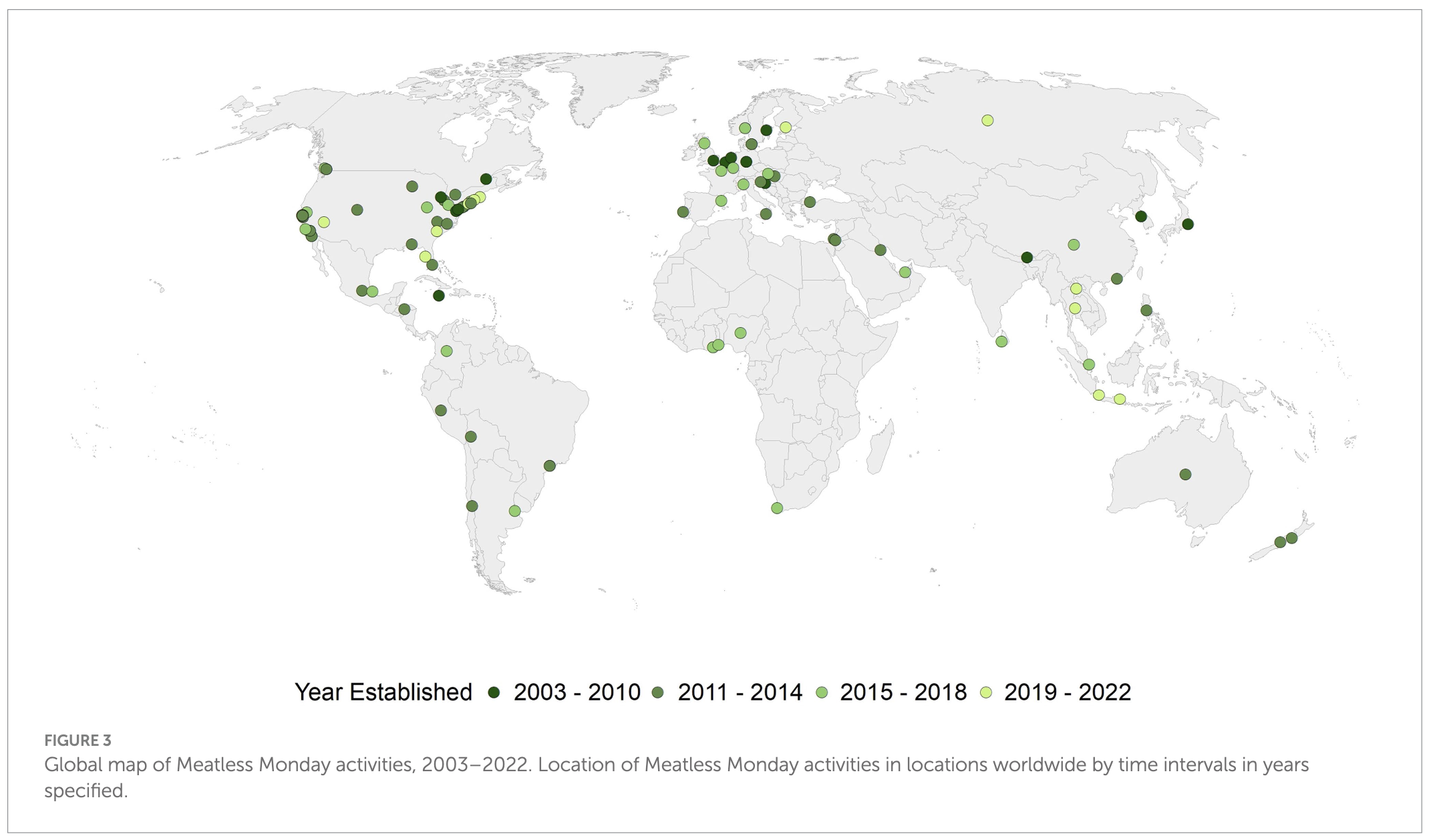
Reading list for review (identified all research up to April 2024)
To update, simply search for new citations of these papers
- Alterma-Johnson et al., 2023
- Pechey et al., 2022
- Rayala et al., 2022
- Ramsing et al., 2021
- de Visser et al., 2021
- Mattson 2020
- Blondin et al., 2020
- Begue and treich 2019
- Morris (2017)
- Conrad et al., (2017)
- de backer, 2014 may not be relevant
- de Boer et al., (2014)
- Morris et al., (2014)
- Sondexo evaluation study Also see here
Around the world
- Meat-Free Monday campaign was initiated in the United Kingdom by Sir Paul McCartney and his daughters Mary and Stella in 2009.
- The same year, Belgium launched Donderdag Veggiedag (Thursday Veggie Day).
- The Meatless Monday campaign, as “Segunda Sem Carne,” was initiated in Brazil by the Sociedade Vegetariana Brasileira in 2009.
- Meatless Mondays Australia was founded in 2009 by Deb Robbins and Vinita Chopra.
- The Norwegian Army adopted Meatless Mondays in 2013
- soaring obesity rates in Argentina, the Casa Rosada, the presidential palace, instituted Meatless Mondays in 2017
Case study: Ghent, Belgium
As of 2017, Ghent had the most vegetarian restaurants per capita in the world, with more than 50 percent of the city reportedly observing vegetarianism for the day (according to polls, people who take part in Ghent’s meatless day end up adhering to a vegetarian diet for an average of three days per week).
References
Milford, A. B., & Kildal, C. (2019). Meat reduction by force: the case of “meatless Monday” in the Norwegian armed forces. Sustainability, 11(10), 2741. ↩︎
Ayers JW, Westmaas JL, Leas EC, et al. Leveraging Big Data to Improve Health Awareness Campaigns: A Novel Evaluation of the Great American Smokeout. JMIR Public Health Surveill. 2016;2(1):e16. Published 2016 Mar 31. doi:10.2196/publichealth.5304 ↩︎
Semba, R. D., Neu, P., Berg, P., Harding, J., McKenzie, S., & Ramsing, R. (2024). The origins and growth of the Meatless Monday movement. Frontiers in Nutrition, 11, 1283239. https://www.frontiersin.org/articles/10.3389/fnut.2024.1283239/full ↩︎