Malnutrition
- Do the global poor need nutrients from animal products
- UN 2030 SDGs
- Solutions to micronutrient deficiencies in LMICs
Hidden Hunger
“Hidden hunger” having enough calories but insufficient vitamins and minerals
- A killer factor affecting both developed and developing countries
Measuring hidden hunger: The Global Hidden Hunger Index
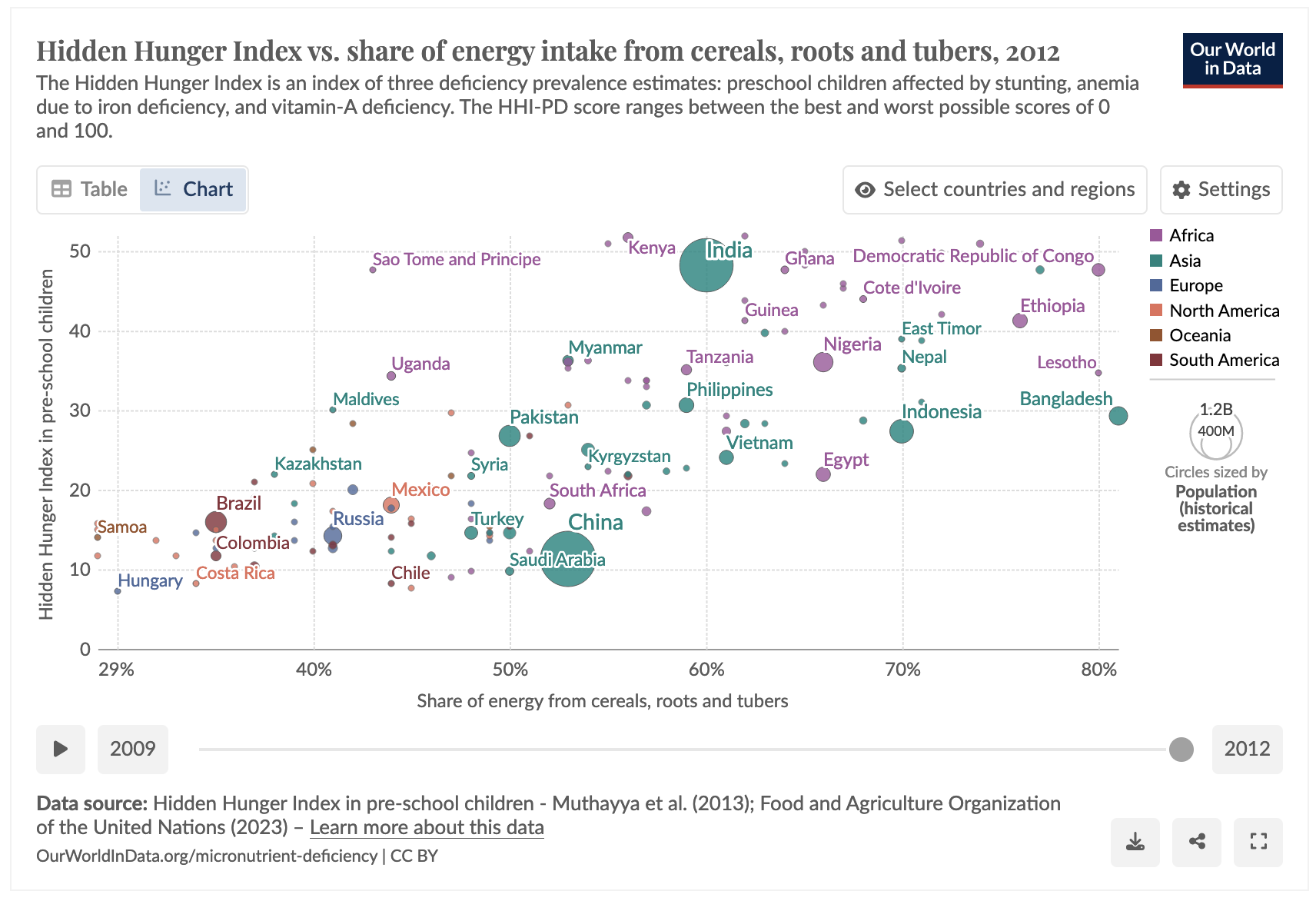
One metric that has been developed to indicate the severity of this is the Global Hidden Hunger Index (GHHI). Note that the terms "hidden hunger" and "micronutrient deficiency" are often used interchangeably. The GHHI is most commonly used to assess the nutritional status of preschool children (under the age of five). The GHHI is calculated as the average of three nutritional indicators in preschool children: the prevalence of stunting (children who are too short for their age), anemia, and vitamin A deficiency.
Key micronutrient deficiencies
- See also Health risks of veggie veganism
The major causes of ‘hidden hunger’ are shortages of:
- protein
- vitamin A
- Iron
- It has been estimated that iron deficiency affects 1.6 billion people around the world (WHO, 2008) and hampers the intellectual development of 40-60% of children in developing countries (UNICEF, 2007). According to a report produced by a number of organizations in 2009, anemia due to iron deficiency during pregnancy is associated with one-fifth of total maternal mortality globally (Micronutrient Initiative, 2009).
- Anemia is hugely prevalent during pregnancy, with even European mothers having rates as high as 22% (not better than LatAm countries)[1]
- zinc
- More than 400,000 children under 5 years are estimated to die each year from zinc deficiency[2]
Additionally Vitamin D deficiency is a problem in basically every country
Malnutrition is a greater problem than not enough calories
-
Feeding the world nutrition over calories, plants over animals
-
Herforth et al., 2022 estimates that whilst in 2017, 381 million could not afford a calorie sufficient diet (5%), 3 billion cannot reasonable afford a healthy diet.
-
Simulations by Nelson et al., (2018) suggest that even in the face of climate change likely damaging agricultural yields, we are comfortably on track for everyone in world to afford enough calories in 2050. What is less certain, is whether everyone will have access to a nutritious diet. Nelson et al., find the risks of hidden hunger remain even if we assume that the world's poorest will double their consumption of both meat and vegetables.
- In all of their simulations, most of the world met requirements for magnesium and phosphorus and niacin, riboflavin, thiamin, vitamin B6 and vitamin C.
- On the other hand, in few scenarios for all world regions, most people would get enough calcium and vitamin D. Iron, potassium, zinc, folate and vitamin E levels were adequate or not depending on the scenario. This suggests that letting the world diet progress as it currently is will not ensure that everyone gets the micronutrients they need. Diet change is necessary. While one might think that calcium requirements require increased dairy, even the high levels of dairy consumed in HICs today is insufficient, so there is no reason to think it would be for other regions in the future. Lower income countries failing to get sufficient zinc, iron and B12 in the future were attributed to insufficient consumption of ASFs. Lower income countries failing to get sufficient folate, Vimains A and K in the future were attributed to insufficient consumption of plant foods.
-
Globally, it’s estimated that over half of children under five years old are micronutrient deficient (in at least one of iron, zinc, and vitamin A).
-
In addition, over two-thirds of non-pregnant women of reproductive age are micronutrient deficient (in at least one of iron, zinc, and folate — also known as vitamin B9)[3]
-
Countries suffering from severe micronutrient deficiencies (HHI> 25) include Nepal, India, Bangladesh, Bhutan, and Laos.[4]
-
The WHO estimates that diets low in fruits and vegetables cause 2.7 million deaths each year and about 19% of gastrointestinal cancer, 31% of ischemic heart disease, and 11% of strokes[5]
References
Hefferon K. Biotechnological approaches for generating zinc-enriched crops to combat malnutrition. Nutrients. (2019) 11:253. doi:10.3390/nu11020253 ↩︎
Stevens, G. A., Beal, T., Mbuya, M. N. N., Luo, H., Neufeld, L. M., Addo, O. Y., Adu-Afarwuah, S., Alayón, S., Bhutta, Z., Brown, K. H., Jefferds, M. E., Engle-Stone, R., Fawzi, W., Hess, S. Y., Johnston, R., Katz, J., Krasevec, J., McDonald, C. M., Mei, Z., … Young, M. F. (2022). Micronutrient deficiencies among preschool-aged children and women of reproductive age worldwide: A pooled analysis of individual-level data from population-representative surveys. The Lancet Global Health, 10(11), e1590–e1599. [https://doi.org/10.1016/S2214-109X(22)00367-9](https://doi.org/10.1016/S2214-109X(22)00367-9 ↩︎
AO. Regional Overview of Food Insecurity in Asia and the Pacific: Investing in a Zero Hunger Generation. Bangkok: FAO (2016). ↩︎
WHO. The World Health Report 2002. Reducing Risks, Promoting Healthy Life. Geneva: World Health Organization (2002). ↩︎