MacInnis & Hodson, (2017)
MacInnis, C. C., & Hodson, G. (2017). It ain’t easy eating greens: Evidence of bias toward vegetarians and vegans from both source and target. Group Processes & Intergroup Relations, 20(6), 721-744.
https://r.jordan.im/download/psychology/macinnis2017.pdf
vegetarians and vegans were evaluated equivalently to immigrants, asexuals, and atheists, and significantly more negatively than Blacks. Vegetarians were evaluated equivalently to homosexuals, whereas vegans were evaluated more negatively than homosexuals. Strikingly, only drug addicts were evaluated more negatively than vegetarians and vegans. In terms of discrimination, however, omnivores did not indicate any less willingness to hire or rent to vegetarians or vegans relative to other groups. indicated more willingness to hire vegetarians than immigrants, atheists, or drug addicts, more willingness to hire vegans over immigrants and drug addicts, and more willingness to rent to vegetarians or vegans than all other target groups.
omnivores are more favorable toward female (vs. male) vegetarians and vegans.
Attitudes toward both vegetarians and
vegans overall were also more negative than atti-
tudes toward those eating gluten free due to celiac
disease, lactose intolerants, and those following a
diet for religious reasons. Attitudes toward both
vegetarians and vegans were more positive, how-
ever, than attitudes toward those eating gluten
free by choice.
In terms of
overall evaluations, both vegetarians and vegans
were evaluated more negatively than environ-
mentalists, vegetarians were evaluated more posi-
tively than feminists, and vegans were evaluated
equivalently to feminists.
those who are vegetarian for
animal rights reasons, were evaluated more neg-
atively than those who are vegetarian for health
reasons or environmental reasons. Those who
are vegetarian for environmental reasons were
also evaluated more negatively than those who
are vegetarian for health reasons. The same
pattern was observed for vegan target
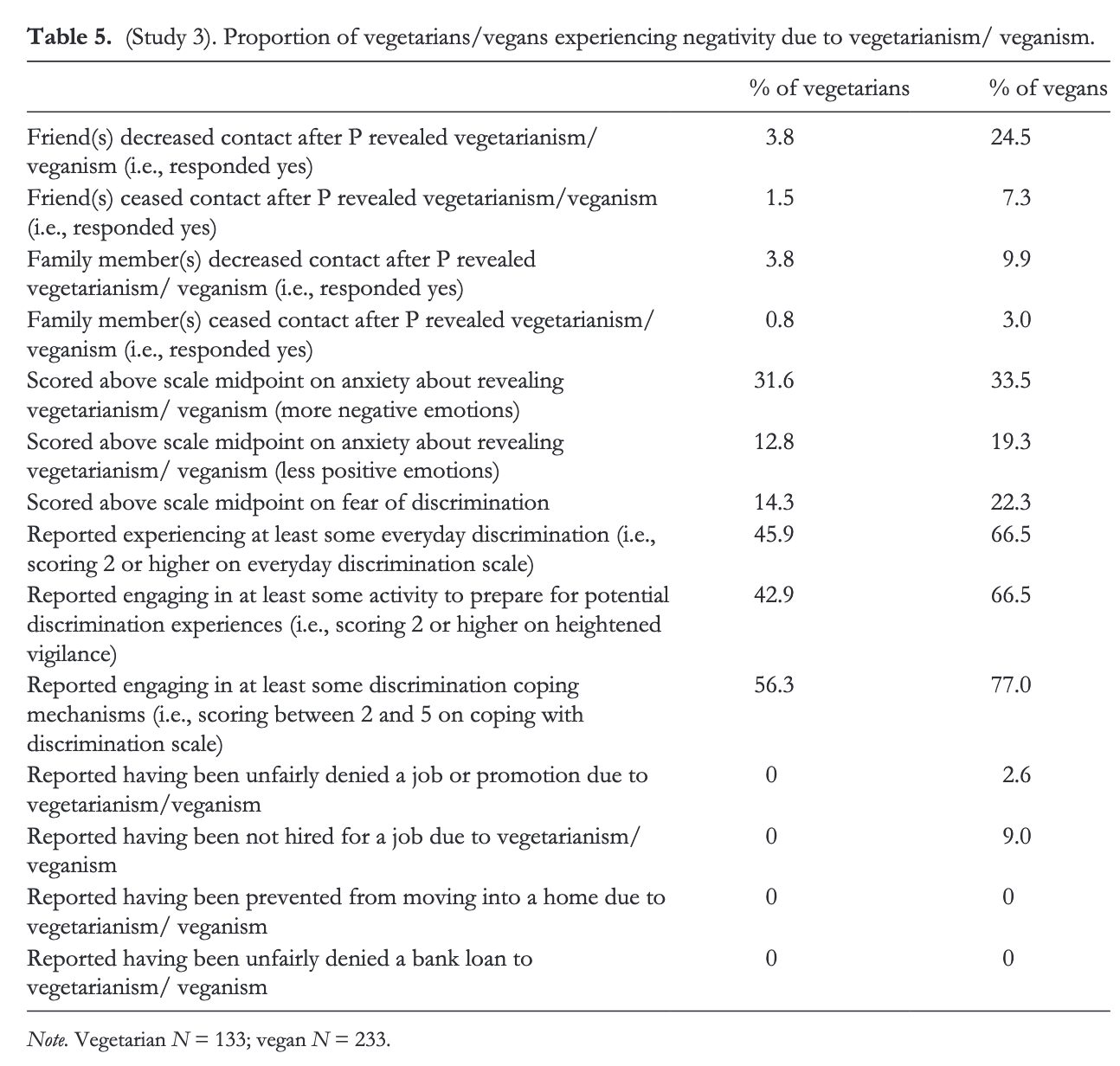
almost one quarter of vegan participants
reported that a friend decreased contact after the
participant revealed their veganism, over one
third of both vegetarian and vegan participants
scored above the scale midpoint on anxiety
about revealing vegetarianism/veganism (nega-
tive emotion items), and over 40% of vegetarian
participants and over half of vegan participants
reported experiencing at least some everyday dis-
crimination, engaging in activities to prepare for
potential discrimination, and engaging in dis-
crimination coping mechanisms. Men did
not report more negative experiences than
women with the one exception: more men than
women reported being unfairly denied a job or
promotion due to their vegetarianism/veganism