Greenpeace, 2024
Shows how mega farms are taking over Europe
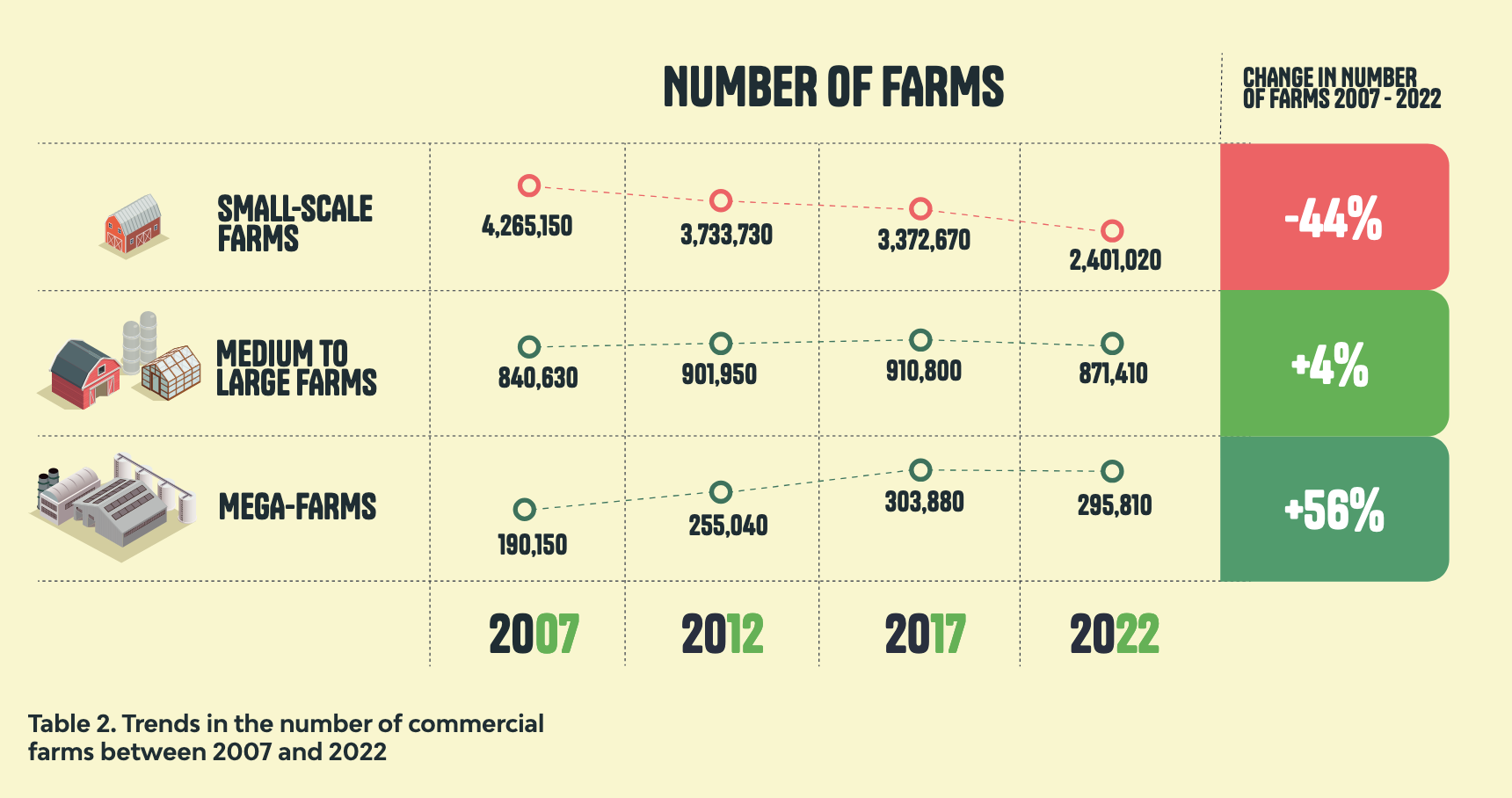
"Even though mega-farms represent only 8% of farms in the EU, they receive 37% of direct payment subsidies for commercial farms, all the while increasing their income (as shown above). Small-scale commercial farms receive only 25% of subsidies, despite over two-thirds of commercial farms in Europe being small-scale."
Debt
An analysis
by the European Investment Bank (EIB) of financing
for agriculture and agri-food enterprises found that
larger farms also have the best access to privatefinance.
Small-scale farms have the
largest financing gap needing credit but unable
to access it. The EIB report highlights that young
farmers and those seeking to make environmentally
friendly investments particularly struggle to secure
loans.
Overall, reliance on bank finance is growing in the
farming sector, which empowers private financiers
to determine the direction of European farming.
These players are far more likely to prioritise quick
profits and rapid returns on capital, over the health
and resilience of the food system or the well-being
of rural areas.
While the net income of many mega-farms has
increased, so too have their debt repayments.
Overall, farms now carry 30% more debt than in
2007, but not all farms have enjoyed similar access to
capital. Small-scale and medium-to-large farms have
actually reduced their debt, while mega-farms have
increased their loans by nearly 90%. This can create
a vicious cycle, further fuelling the drive to “go big
or go bust,” as farms need to scale up production in
order to repay their loans.
Consolidation
The top 8% of
highest-producing farms now control 63% of the
livestock in the EU and 36% of the EU’s agricultural
land. This leaves two-thirds of EU farms the 67%
with the lowest economic output with only 11% of
livestock and 25% of farmland.