Going vegan is good for the environment
-
A milder version of this argument: Modest meat reduction can have significant environmental benefits
-
food and meat accounts for a large proportion of greenhouse gas emissions
-
Conrad, Drewnowski, & Love, (2023) find that vegan diet was better for the environment than other popular diets (Low grain, low carb, low fat, and fasting)
-
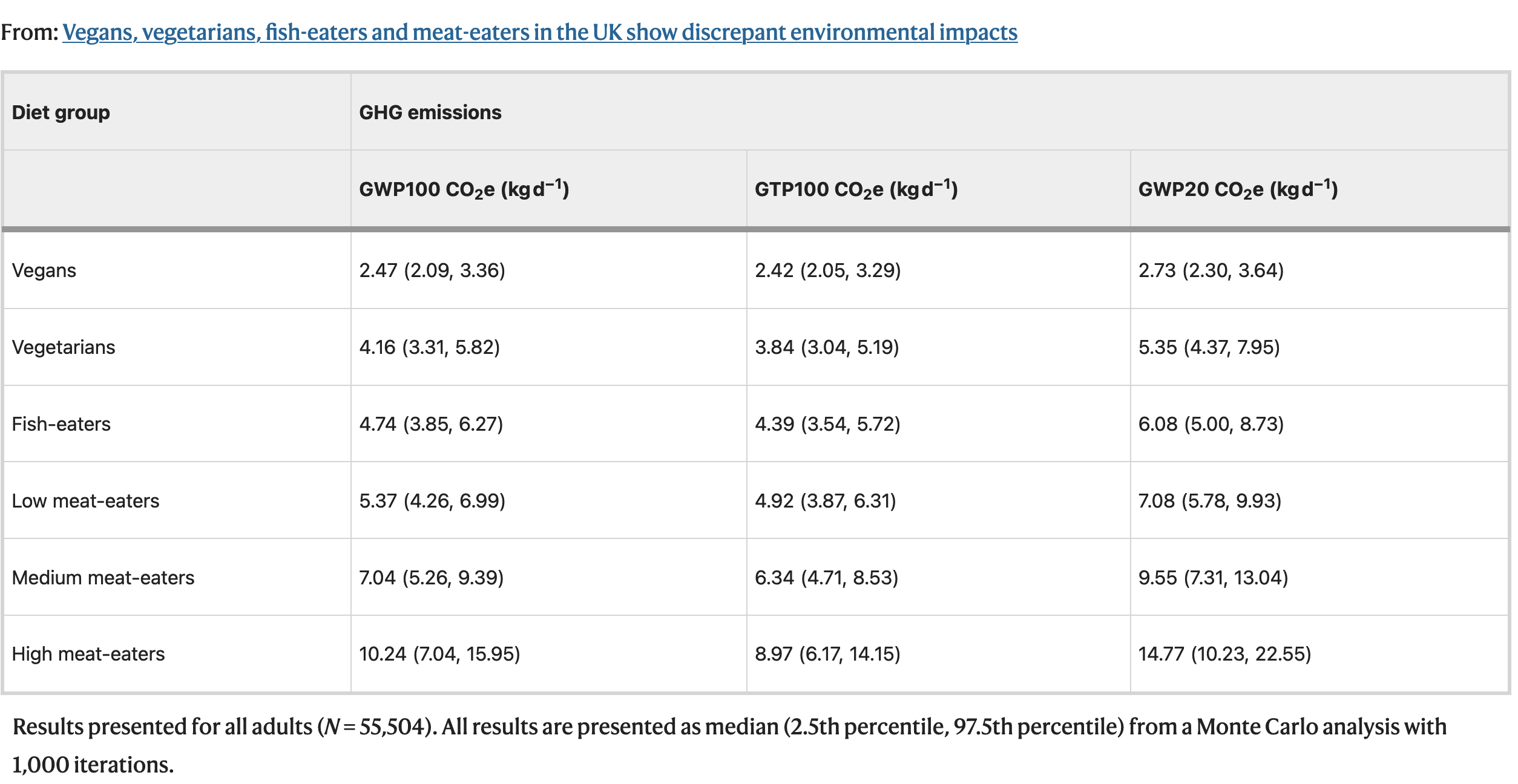
Scarborough et al., 2014 estimate that vegans have half the GHG emissions from diet than moderate meat eaters.
-
Ivanova et al., 2020 reviewed 53 studies and found that veganism reduced carbon emissions by about half what going car free did
-
Scarborough et al., 2023 reviewed 570 life-cycle assessments covering more than 38,000 farms in 119 countries and found that
See also: Why not eat better meat rather than less meat
Impactful stats
a small steak causes about 5kg of carbon emissions (equivalent to approximately half an hour of driving), while an equivalent portion of a vegetarian meat-replacement is responsible for less than 0.5kg of carbon.
A review by Aleksandrowicz et al., 2016[1] found decreases in GHGE of 3% to 36% when meat from ruminant animals (eg, beef or lamb) was replaced with meat from monogastric animals (eg, chicken or pork), and decreases of 15% to 58% with changes to vegetarian diets.
Berners-Lee et al., 2012 estimated that if the UK followed a veggie/vegan diet (they modelled 6 options to do this), we could reduce the UK's GHG by 22-26%, equivalent to taking half the UKs vehicles off the road.
Springmann et al., 2023 estimate that the health and economic gains from going PB could be huge
How much is my personal GHG emissions reduced by going vegan?
There are 2 things to consider here:
- What is the reduction in your dietary GHG emissions?
- What is the reduction in your total, personal GHG emissions?
References
Aleksandrowicz, L., Green, R., Joy, E. J., Smith, P., & Haines, A. (2016). The impacts of dietary change on greenhouse gas emissions, land use, water use, and health: a systematic review. PloS one, 11(11), e0165797. ↩︎