Future smart foods
-
Li, Yadav & Siddique, 2020 discuss case studies of the Indian government explicitly tackling iron and vit A deficiencies with dark green leafy vegetables such as kale and lentils (lentil and kale are a powerful combo[^4]).
-
An estimated 75% of crop genetic diversity has been lost since the 1900s (FAO, 2017)
-
Even Bill Gates has shown excitement about the potential of millets as Future Smart Foods.
Examples
- Canahua, an underutilized Andean grain, is remarkably frost tolerant.
- Millets
- Teff, used to make Ethiopian injera, and the only grain that is high in vitamin C
- Finger millet, cultivated across East Africa, with 10x the calcium of wheat
- Millets like Fonio are remarkably easy to farm, is drought tolerant and grows in poor soil. As a result is is cultivated in the Sahel Desert and is sometimes affectionately referred to as the "lazy farmer's crop". It also contains good amounts of iron and zinc. Fonio fell out of favour because it is hard to commercially process.
Case study: millets in India
One focuses within the FSF initiative in India is on millets and sorghum, collectively referred to as nutricereals. Millets are healthier than typical staple crops such as maize (corn), rice and wheat, containing higher levels of vitamin A, calcium, iron, zinc, riboflavin, and folic acid, which are all nutrnets. These grains are being repositioned from their traditional image as "old-fashioned" to smart food options due to their nutritional benefits, drought resistance, and lower environmental footprint. The Smart Food Initiative aims to mainstream millets through various strategies, including improving consumer awareness, enhancing the supply chain, and fostering innovation through incubators for millet entrepreneurs. Notable efforts include the collaboration between the International Crops Research Institute for the Semi-Arid Tropics (ICRISAT) and the Indian Institute of Millets Research (IIMR), as well as support from government initiatives like the declaration of 2018 as the National Year of Millets and the inclusion of millets in mid-day meal programs.
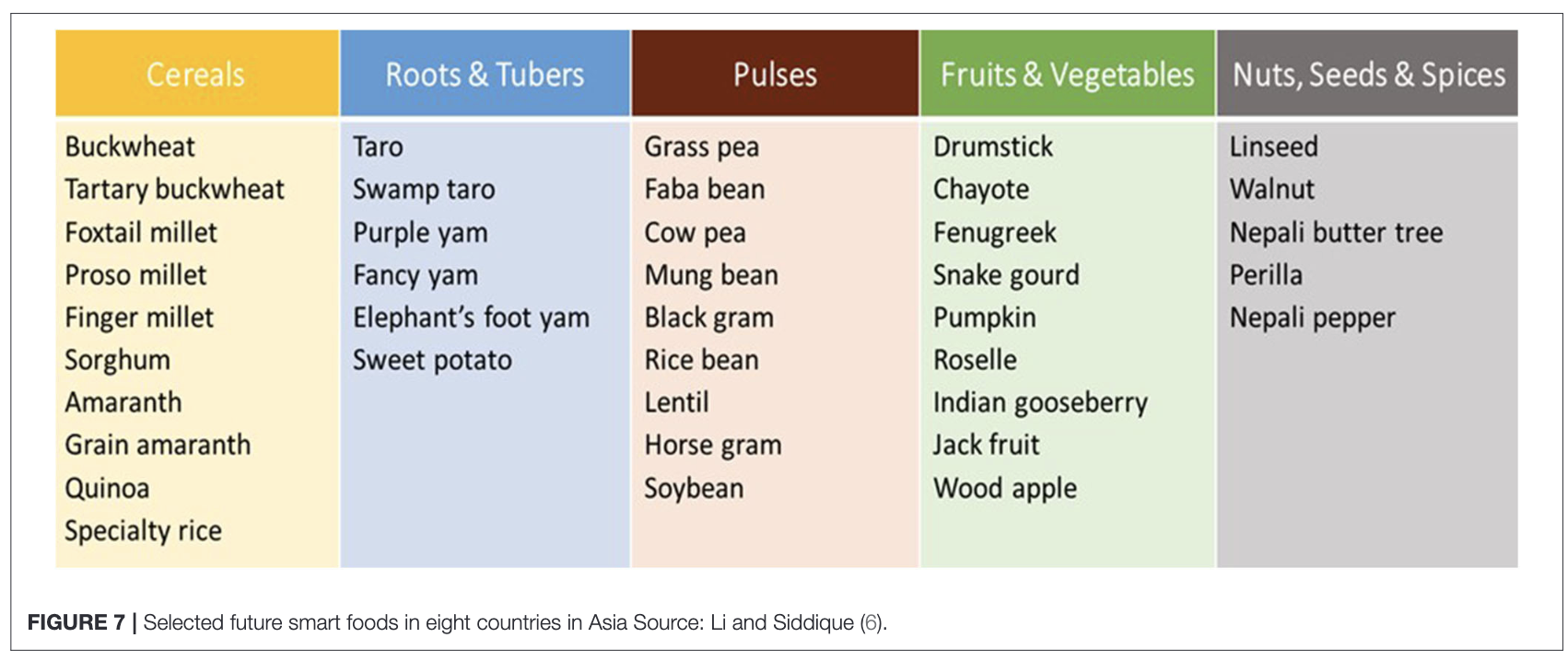
Source: Li and Siddique (2020)
Future smart foods to address malnutrition
Future Smart Foods (FSF) are a worldwide initiative championed by the FAO and Bill Gates. Future Smart Foods are a subset of "Neglected and Underutilized species" that are also nutrient dense, climate resilient, economically viable, and locally available or adaptable (FAO, 2018). By definition, these foods are selected to tackle food security from multiple angles:
- They improve food access for smallholders in remote rural areas. This because they require few inputs; remote rural farmers may not have reliable access to specialist seeds, veterinarians and farming and processing machinery.
- They improve food utilisation by being high in micronutrients. For example, lupin contains five times more protein, eight times more dietary fibre, four times more iron and 44 times more folate than rice.
- They bolster food stability by improving the diversity of crop species cultivated in an area, as well as being locally adapted and drought tolerant.
One example of a Future Smart Food are the leaves and seeds to the Persian Moringa tree. It is able to grow in arid and desert regions and the leaves and seeds contain high levels of vitamins A and C, as well as calcium and potassium. Another example is Chaya, or tree spinach that is popular and native to Mexico and Central America but is grown as far as Cambodia. It grows fast, is drought and disease resistant, and high in protein, iron and vitamin C. It may also provide a good source of income to growers as it is cheap to produce and appealing to tourists from high income countries.
Other examples of promising Future Smart Foods are millets such as finger millet, Teff or Fonio. These are collectively referred to as nutricereals. Teff is used to make the popular sour flatbread Injera that is the hallmark of Ethiopian cuisine. Notably, it is the only grain high in vitamin C. Millets typically contain higher levels of vitamin A, calcium, iron, zinc, riboflavin, and folic acid than staple crops, and . The Gates Foundation alongside CGIAR see millets as playing a promising role in addressing micronutrient deficiencies across the world and the UN declared 2023 "The Year of Millet". This followed the Indian Government taking a great interest in millets as a food security fix and declaring a nationwide year of millet in 2018.
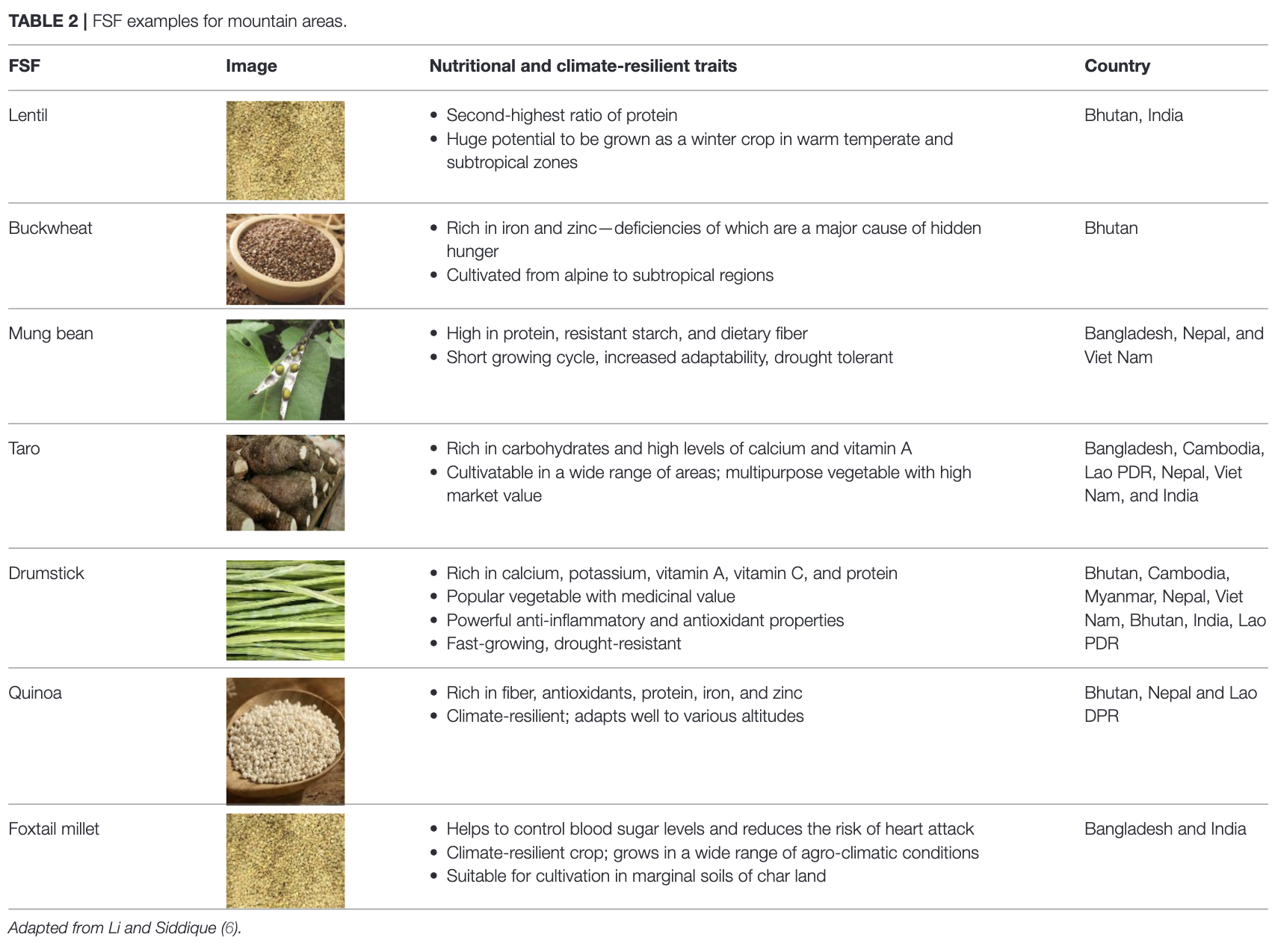
Figure XX: examples of Future Smart Foods that excel in mountainous regions where soil is often poor. From Li and Siddique (2020)
Despite having strong advantages, there are some barriers to widespread adoption of FSFs. Gates notes that some types of farming millet are difficult to scale because we haven't yet developed machines to process them efficiently. Knez et al., (2023) present 7 case studies of FSFs and the key barriers to increasing their adoption, including buckwheat, lentils, green leafy vegetables, sow thistle, grass pea, cucumber melon, and eggplant. Common themes around barriers include lower yields and lack of genomic sequences preventing rapid breeding improvements. There is also a cultural element: they are often perceived as "old fashioned" and "food for the poor". This negative image in the eyes of consumers can result in low market prices. This was found in a study of farming villages across Nepal and Bangladesh, who are farming less buckwheat and millet and more cash crops such as fruits and coffee. As such, public education campaigns of the numerous benefits of these foods, such as those seen in India, are key to ensuring that their potential to tackle food insecurity is realised.