Food security
-
Chronic and temporary, urban and rural
-
As of 2006 40 countries enshrined a right to food
Food security maps and stats here: https://ourworldindata.org/food-insecurity
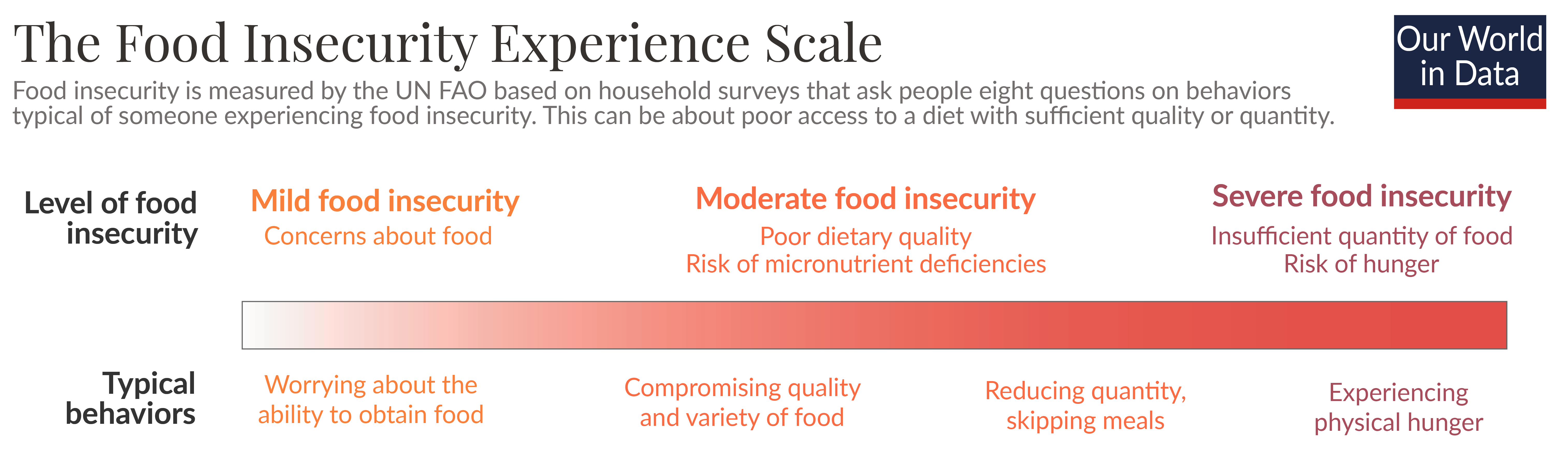
The Food and Agriculture Organization of the United Nations, The State of Food Security and Nutrition in the World 2023 estimate that About 29.6 percent of the global population – 2.4 billion people – were moderately or severely food insecure in 2022, of which about 900 million (11.3 percent of people in the world) were severely food insecure.
Moderate or severe food insecurity affected 33.3 percent of adults living in rural areas in 2022 compared with 26.0 percent in urban areas.
FAO's 4 pillars:
https://www.fao.org/fileadmin/templates/faoitaly/documents/pdf/pdf_Food_Security_Cocept_Note.pdf
- Food availability: can you get enough food, through local production, imports or food aid. This is the supply side of food. Food security here is all about raising yields.
- Food access: the affordability and allocation of food, as well as the preferences of individuals and households requirements of each member of the household[1].
- This might be measured on the % of household income spent on food.
- Affordability is defined by Herforth et al., 2022 as less than 52% of ones income (Herforth discuss affordability at length)
- Allocation is access to markets
- Preference is about whether people can acquire foods in line with their culture and values. It's about social norms around food.
- Utilisation:
- Food safety: sanitation, healthcare and clean water. Disease prevents absorption of food. Also high pesticides or processing methods.
- Nutritional content of food
- Stability of availability and access over time
Food agency as the 5th pillar
Agency is the capacity of individuals or groups to make their own decisions about what foods they eat, what foods they produce, how that food is produced, processed and distributed within food systems, and their ability to engage in processes that shape food system policies and governance (HLPE 2020).
Food sovereignty
Food sovereignty is the right of peoples to healthy and culturally appropriate food produced through ecologically sound and sustainable methods, and their right to define their own food and agriculture systems. It puts the aspirations and needs of those who produce, distribute and consume food at the heart of food systems and policies rather than the demands of markets and corporations. It defends the interests and inclusion of the next generation. It offers a strategy to resist and dismantle the current corporate trade and food regime, and directions for food, farming, pastoral and fisheries systems determined by
producers and users. Food sovereignty prioritizes local and national economies and markets and empowers peasant and family farmer-driven agriculture, artisanal – fishing, pastoralist-led grazing, and food production, distribution and consumption based on environmental, social and economic sustainability. Food sovereignty promotes transparent trade that guarantees just incomes to all peoples as well as the rights of consumers to control their food and nutrition. It ensures that the rights to use and manage lands, territories, waters, seeds, livestock and biodiversity are in the hands of those of us who produce food.
transport or food distance
The farther away a person lives from a major city or town, the less access to food he or she enjoys. Transportation is a major factor in food insecurity. If a person or family lacks transportation, obtaining food from places even a few miles away can become impossible. Even if they can travel to more populated areas on foot, there’s only so much they can carry.
Food security can be low even among the overweight
- Poor people in the developed world may have access to enough calories, but not enough access to proper nutrition, so they may lack food, utilisation but be overweight
- Malnutrition
Food insecurity is often caused by lack of distribution of food, not lack of food
References
Ingram, J., 2009. 2. Food system concepts, in: ESF (Ed.), European Food Systems in a Changing World - Report of a ESF/COST Forward Look. European Science Foundation, Strasbourg. ↩︎