UK governmental food security review, 2024
Overall self sufficiency
The overall self sufficiency of the UK diet is moderately good; we produce 62% of our food supply, importing 38%. Some of our favourite foods like bananas and citrus fruits cannot be grown at scale in the UK, and if we remove these foods from the calculation (i.e. we count only "indigenous foods"), the figure is higher at 75%. This figure has remained broadly stable for the last 20 years. However, as we will see, this overall picture masks a poor vegetable sector, and factory farming makes this number look higher than it is.
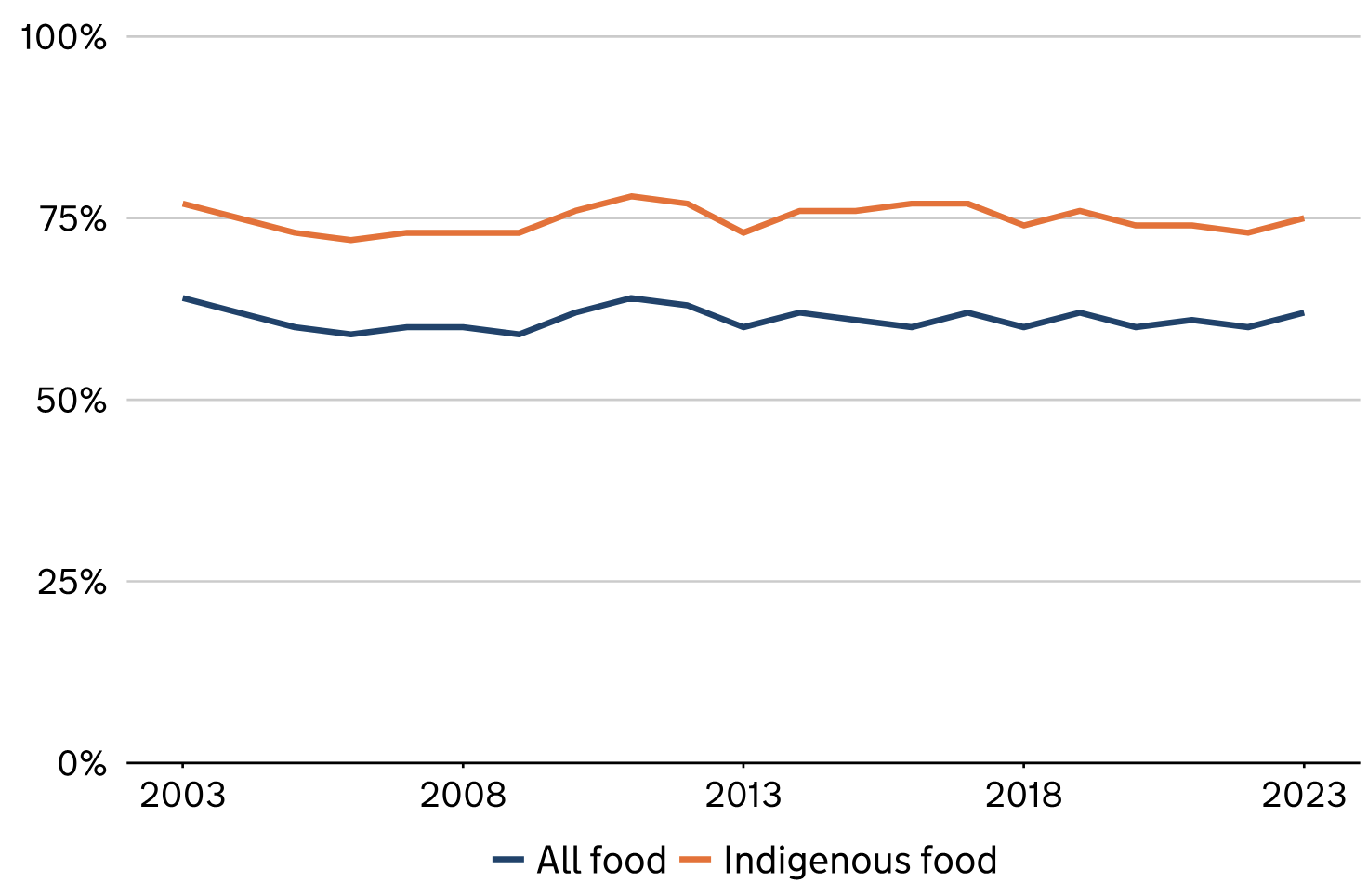
UK production to supply ratio over timeSource: Agriculture in the UK (Defra)
| Food type | self sufficiency in 2023 |
|---|---|
| All cereals | 93% |
| Wheat | 96% |
| Barley | 113% |
| Oats | 120% |
| Fresh vegetables | 53% |
| Fresh fruits | 16% |
| Beef | 85% |
| Pork | 64% |
| Lamb | 114% |
| Poultry | 82% |
| Milk | 105% |
| Eggs | 87% |
| Source: Agriculture in the UK (Defra), Horticultural statistics (Defra) |
Animal feed
- In 2023, 51.8% (11.4 million tonnes) of wheat, barley and oats were used as animal feed
Four processors account for approximately 90% of UK poultry production – 2 Sisters, Avara Foods, Moy Park and Cranswick.
Abattoirs and the meat processing industry in general have been challenged with
labour shortages over the last 3 years.
Bird flu and egg prices
- Richie note: the framing is that we have to choose between consumers seeing price hikes or farmers bearing it and exiting the industry.
Between 2021 and 2023 the production of eggs for human consumption
decreased by 14.6% to 855 million dozen. There had been a tightening of the egg
market since April 2022 as a result of rising input costs for feed and energy. These
were partly caused by Russia’s invasion of Ukraine, along with the impact of Avian
Influenza outbreaks in 2021 to 2023. As these increased costs were being borne
primarily by the producers and not being passed fairly along the supply chain, a
number of egg producers took the decision to stop egg production either
temporarily, or in some cases permanently. During 2023 the supply chain adjusted
with the increased costs being more fairly distributed and this led to a gradual
increase in egg prices.
Vegetables
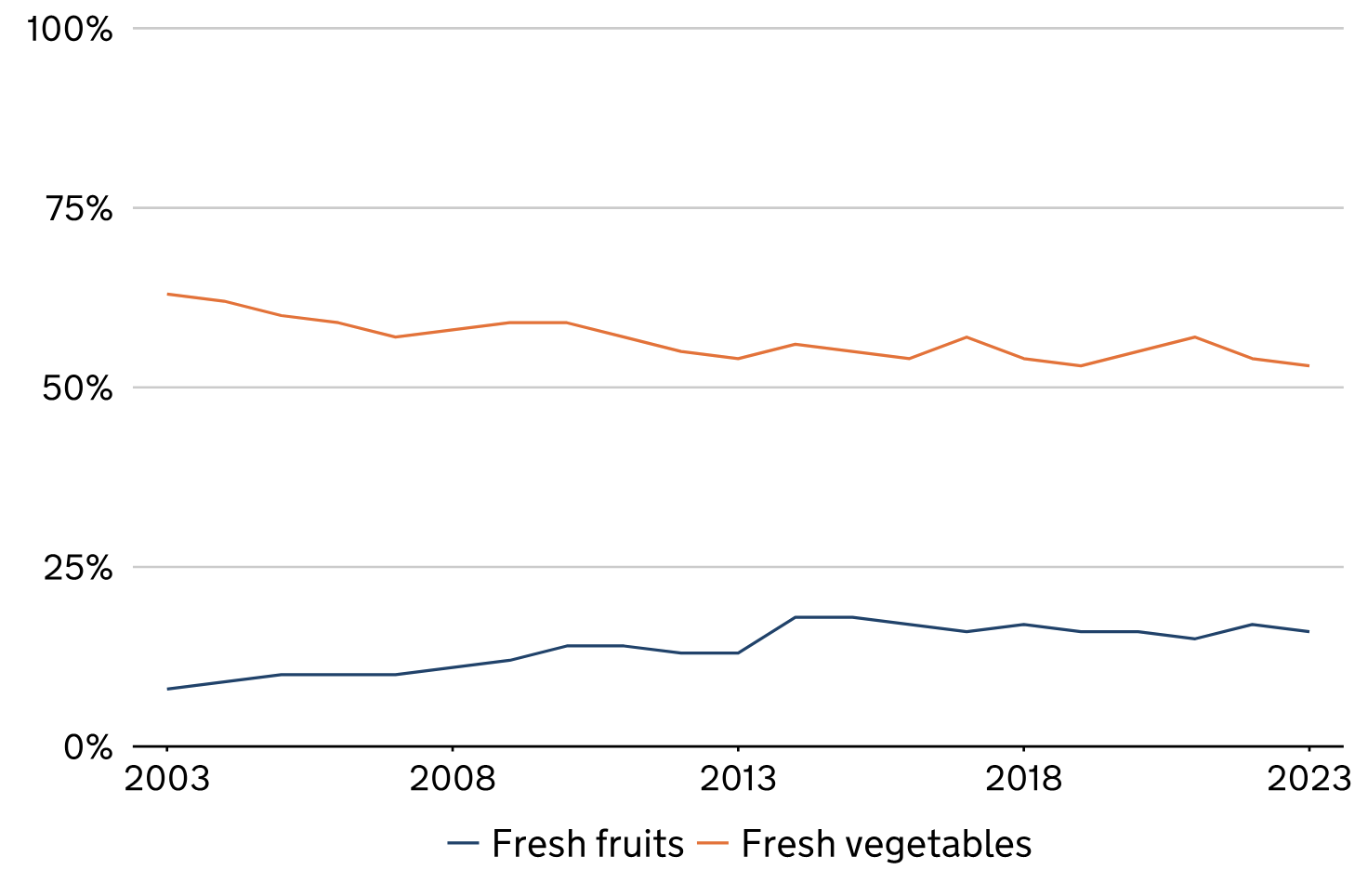
Whilst we're making small improvements in fruit, vege production is getting worse
In 2023 the production to supply ratio of fresh vegetables was 53%, down from 63% in 2003. Fruit is far worse: in 2023 we grew just 16% of our fruit, though this is considerably better than the 8% of 2003.
| Food Type | 2023 |
|---|---|
| Apples | 38% |
| Pears | 13% |
| Plums | 13% |
| Strawberries | 66% |
| Raspberries | 38% |
| Cabbages | 81% |
| Cauliflower and Broccoli | 49% |
| Carrot, Turnip and Swede | 96% |
| Mushrooms | 48% |
| Lettuce | 44% |
| Tomatoes | 15% |
Good stuff in here on soil, biodiversity, water quality,