UK governmental food security review, 2021
FFD - Food feed and drink
A long list of ecological and social risks can be derived from UKFSR: pollinator decline, weather extremes, over-fishing, fertiliser disruptions (particularly phosphates), soil depletion, seasonal worker shortages, price uncertainties, unmet need, a population with poor diet-related ill-health, and more.
It argues that domestic production is mostly led by consumer demand, meaning that production can change in the face of changing diets.
Imports and exports
There’s a yawning £24bn negative food trade gap.
Overall, the UK’s food supply is concentrated on the UK and Europe, with over 80% of supply coming from these main sources. The remainder is mostly spread between Africa, Asia, North America, and South America. . 39% of FFD imports by value were despatched from 4 EU countries (the Netherlands, Republic of Ireland, Germany, and France) in 2020.
We are a net exporter of low value meat items and importer of high value meat items.
The ratio of farmgate value of raw food production vs value of raw food for human consumption.
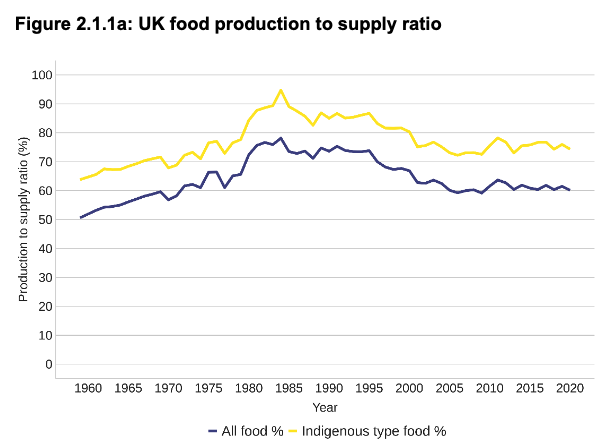
The production to supply ratio is estimated to be 60% for all food in 2020 and 76%
for indigenous type food (that which can be commercially grown domestically).
Actual consumption of UK-produced food is closer to 54%, as a part of UK
production is exported.
Fish
The UK both produces and consumes fish and seafood, but is a net importer overall. UK consumer preference is for fish mainly caught outside UK waters, such as cod, haddock, tuna, and shrimp and prawns. This means that the UK exports much of what it catches and imports much of what it eats. Supply sources for imports are diverse, with northwest Europe and China the most significant sources. Most of the fisheries which supply UK imports are well managed and have sustainable stocks, although climate change presents a risk to fish stocks. The UK has a significant fishing fleet which mainly exports to the EU, US and China. Important exports include herring, mackerel, salmon and nephrops (scampi).
Land
Competition for land use is increasing.
Seems like most land can't be converted to crops
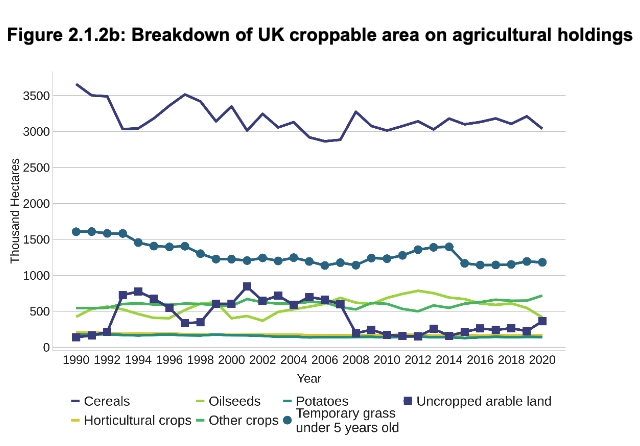
An exception is the decline since 2018 in land given to oilseeds, which partly reflects increased pesticide resistance among stem flea beetles and the withdrawal of neonicotinoid insecticides.
Crops
- The UK is largely self-sufficient in barley and oats, and 81% self-sufficient in milling wheat (slightly higher for wheat overall)
- It is not likely or desirable for this figure of 81% to rise much higher, as the remaining percentage is largely made up of hard wheat types not suited to the UK’s climate and soils. Further to this, global competition in wheat production and prices means there is significant economic risk involved with trying to fully meet domestic milling needs, since any surplus could be undervalued relative to the costs incurred during production.
Fruit and veg
Livestock and feed
- In 2020, seeds cost UK farmers £922m, fertilisers £1,147m, energy and fuel £1,290m, pesticides £1,097m, and animal feed £5,586 million. Animal feed is both the most expensive input across the entire sector and the one for which prices fluctuate most.
- the 2020 cost of feed (£5.6 billion) with the £13.8 billion combined value of livestock production it is clear that livestock production remains vulnerable to changes in feed prices, for example through competition with energy crops, poor harvests, and global competition for grain. In 2020, £2.5 billion of animal feed was imported, and £1.1 billion exported, about 60% of both with EU countries. This means net dependency on imports is about 25% of total feed cost but actual use of feed imports is closer to 45%.
Soil health
- Estimates suggest soil degradation, erosion, and compaction are costing about £1.2 billion each year and reducing the capacity of UK soils to produce food.
Pesticide use
Biodiversity
Climate change
- Climate change represents a risk to production both in terms of making conditions unsuitable for some crops and allowing new pests to proliferate but it may also benefit new types of crops.
- As a consequence of unusual weather patterns linked to climate change, wheat yields in 2018 were 7% below the 2016 to 2020 average, and 17% down in 2020
Key inputs
Key inputs are those chemicals, ingredients and additives used in the production, supply, and storage of essential food items. Essential food items are products that are recommended for a nutritionally balanced diet in line with the Eatwell Guide (for example cheese, fresh meat, bread). Key inputs include all inputs from farm to fork, with products as diverse as fertilisers and chilled meats. In manufacturing, sodium hydroxide (NaOH) is a key input as it is a cleaning agent necessary for the safe and hygienic manufacturing of food. Other examples of key inputs include ammonium nitrate (fertiliser), ethylene glycol (refrigerant), wheat flour (ingredient), tinplate (packaging), potable water, and fresh fruit and vegetables (ingredient).
Shock
The summer of 2018 when there was a shortage of CO2. CO2is a by-product of ammonium nitrate fertiliser production, so low fertiliser prices across Europe affected the commercial viability of CO2 production. Several UK and EU manufacturers capitalised on the opportunity to shut plants for maintenance works. Hot summers made the problem worse because of demand for fizzy drinks.