The Landworkers’ Alliance, Pasture for Life, Sustain and Hodmedod (2023)
"Soy No More": https://www.sustainweb.org/reports/jun23-soy-no-more/
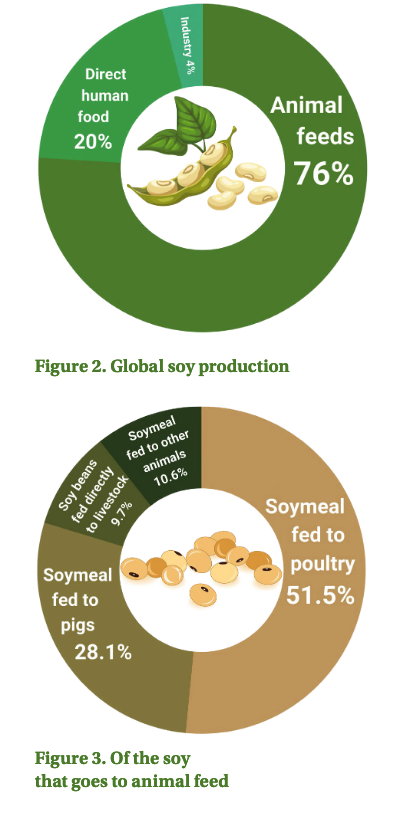
Nearly 90% of the UK’s soy imports are used for animal feed – the majority of which is consumed by the industrial pig and poultry sector.
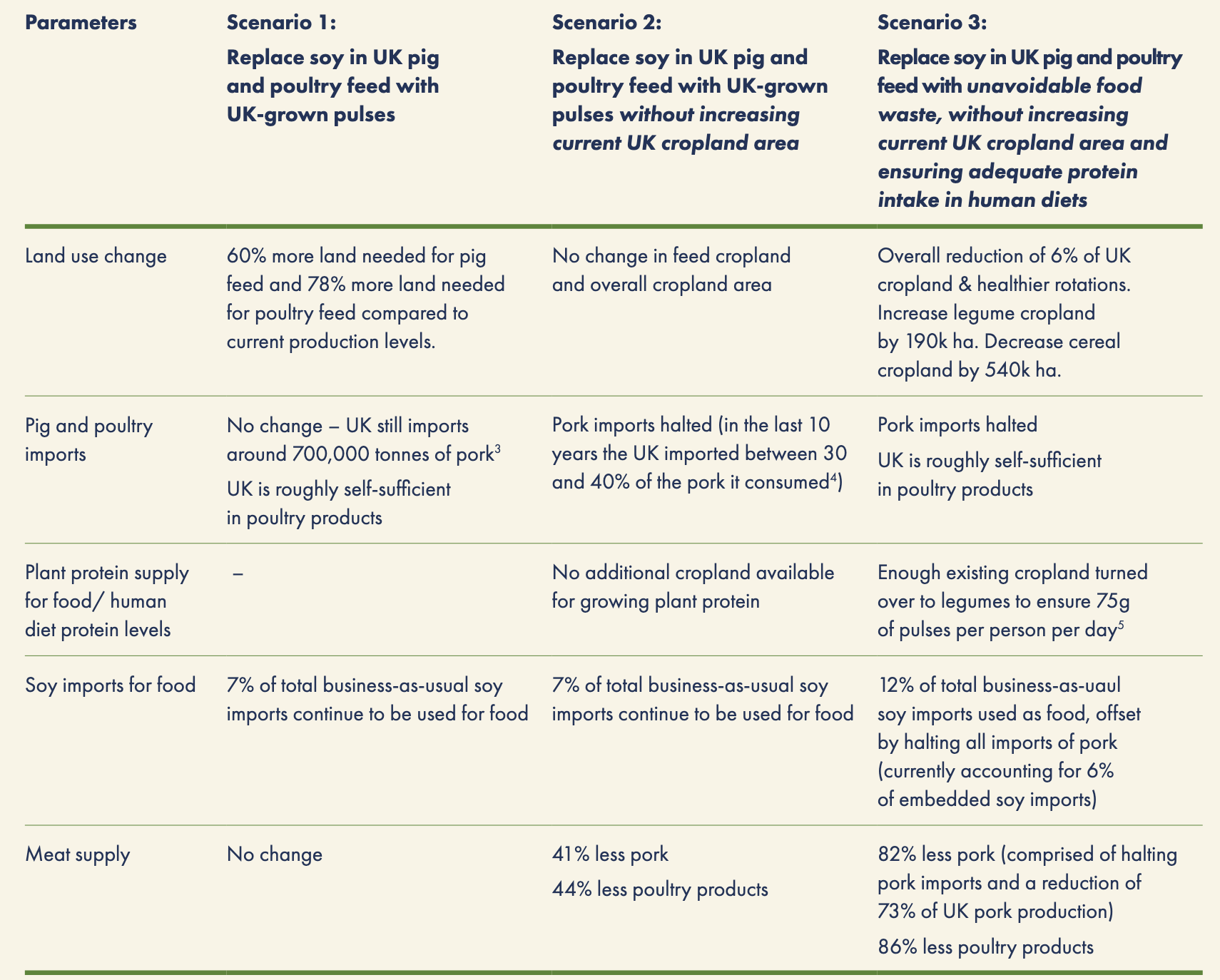
The first scenario models replacing soy in UK pig and poultry feed with home-grown legumes. If we were to keep production and consumption of pig and poultry feed the same as it currently is, our modelling demonstrates that UK total cropland for pig feed would need increasing by an estimated 60%, and for poultry feed by an estimated 78%.
The second scenario takes land-use into consideration and demonstrates that if we were to replace soy with home-grown legumes without increasing total UK cropland area, we would need to eat 44% less poultry and 41% less pork.
The third scenario not only takes land-use into consideration, but also food-feed competition. It explores what might be possible if current UK cropland area was prioritised for growing pulses for human consumption, and pig and poultry were fed on by-products and food waste inedible for humans, such as heat-treated food waste, insect feed, pasture, and co-products from pulse production.
To ensure people living in the UK have an adequate protein intake – from both plants and animal products – calculations for this third scenario estimate that pig and poultry production would have to decrease by over 80%. To put this into perspective, this report also highlights how the majority of the UK’s poultry production is embedded within large-scale, vertically integrated supply chains dominated by agribusiness corporations, and that pig production remains highly concentrated in large-scale operations.
Between 2016 - 2021 the price of soy on international markets fluctuated between £300/tonne and £380/tonne, and in 2022 rose as high as £500/tonne Food security in the UK
Misc notes
Soy, pesticides and the rainforest
In 2018 Brazil was found to be the world’s biggest consumer of pesticides classed as seriously hazardous to health or the environment. These hazards included acute toxicity to humans, chronic exposure risks like cancer or reproductive failure, high persistence in the environment, and high toxicity to bees. Almost two-thirds of this Brazilian highly hazardous pesticide spending went on the country’s soy plantations.
Replacing soy in pig feed
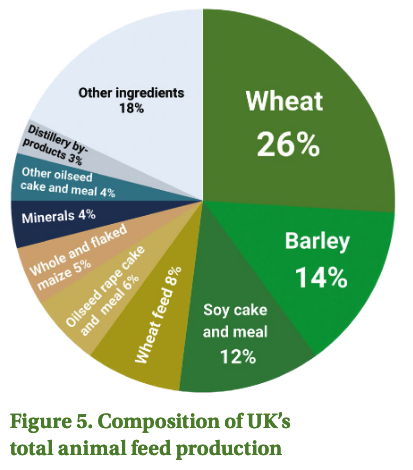
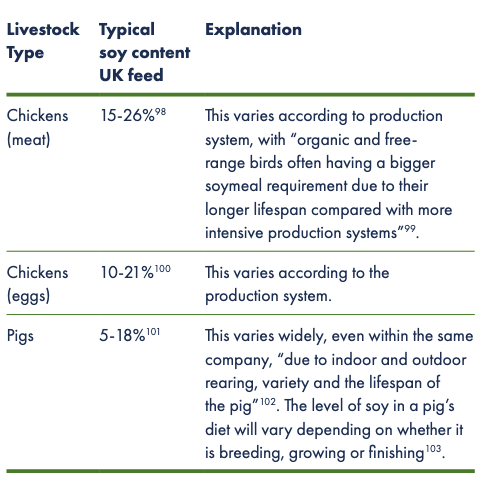
The reluctance of the pig industry to include home-grown pulses in pig diets is mainly due to a long-standing perceived association between high inclusions of peas or fava beans in pig diets with poor growth performance.¹⁰⁴ Moreover, industry view peas, beans and rape seed to be less palatable to pigs than soy.¹⁰⁵ Even so, according to the UK pig industry, the proportion of soy used in pig feed has reduced from 20% to around 10% over the last 10 years¹⁰⁶ thanks to increased use of rapeseed and sunflower oil and coproducts such as distillers’ grains.¹⁰⁷ Soy’s high protein content of more than 40%, as well as the year-round predictable supply make the industry reluctant to substitute soy completely.