Springlea, 2022
https://www.animalask.org/post/subsidies-which-reforms-can-help-animals
Executive summary
To do as much good for animals as we can, it is important to understand the systems that are causing animals to suffer and die - and how to reform those systems to help animals.
One way to reform modern animal agriculture is through subsidies. Subsidies are payments made by governments to businesses or people. Some subsidies can have profound effects on the lives of animals. For example, governments can pay farmers to produce more meat, which can harm animals. On the other hand, governments can pay farmers to adopt practices that improve animal welfare, which can help animals. Promoting or abolishing these subsidies could therefore be an effective way for animal advocacy organisations to do good for animals.
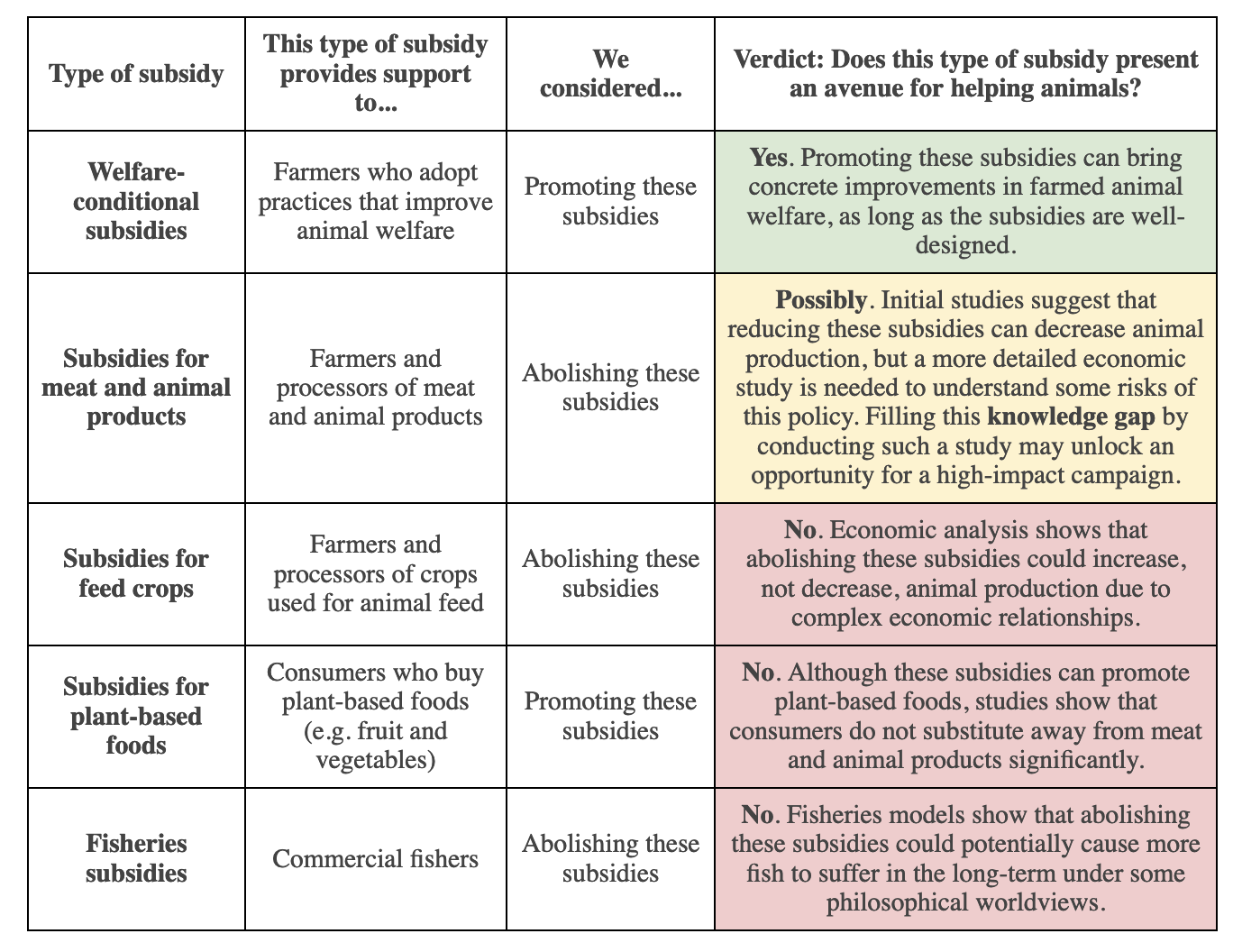
In this report, we examine five types of subsidy reforms in animal agriculture, and we evaluate which of these reforms could be impactful campaign options for animal advocacy organisations.
Promoting welfare-conditional subsidies appears to be an impactful campaign. This type of subsidy involves the government paying farmers to adopt higher-welfare practices. Evidence from Switzerland and the EU suggests that this type of subsidy can bring concrete improvements in animal welfare, and tentatively even reduce the production of animal products, so long as the subsidies are well-designed.
Abolishing or reducing subsidies for meat production also has the potential to be an impactful campaign, but additional research is needed first and this is context-dependent. Initial studies suggest that abolishing these subsidies could decrease animal production. But there is also the risk that abolishing these subsidies could shift production away from cows and towards chickens, which could result in more animal suffering and death overall. Before any campaigns take place, a more sophisticated economic analysis is needed to provide more detail about the contexts in which this campaign could be good for animals.
The other three options we examined do not appear capable of helping animals. These options were abolishing subsidies for feed crops, promoting subsidies for plant-based foods, and abolishing fisheries subsidies. Each of these three options would either achieve nothing or even possibly harm animals.
We recommend that animal advocacy organisations consider campaigning for welfare-conditional subsidies, by which farmers are paid for adopting higher-welfare practices. This could involve increasing these subsidies in places where they already exist (Switzerland, the EU, and England) or establishing them in further countries. And we note that although this is the most promising subsidy campaign, the context in a particular country will determine if this campaign has a higher impact overall than other animal advocacy campaigns. This campaign should be one of many that organisations systematically analyse when considering which campaign would do the most good for animals.
We also recommend that a detailed economic study be conducted on the effects of abolishing subsidies for meat production. Such a study could unlock an opportunity for another high-impact campaign.
Lastly, we conclude with some strategic considerations that may help organisations campaign for subsidy reform.