Shaping UK land use (Green Alliance)
https://green-alliance.org.uk/wp-content/uploads/2023/01/Shaping-UK-land-use.pdf
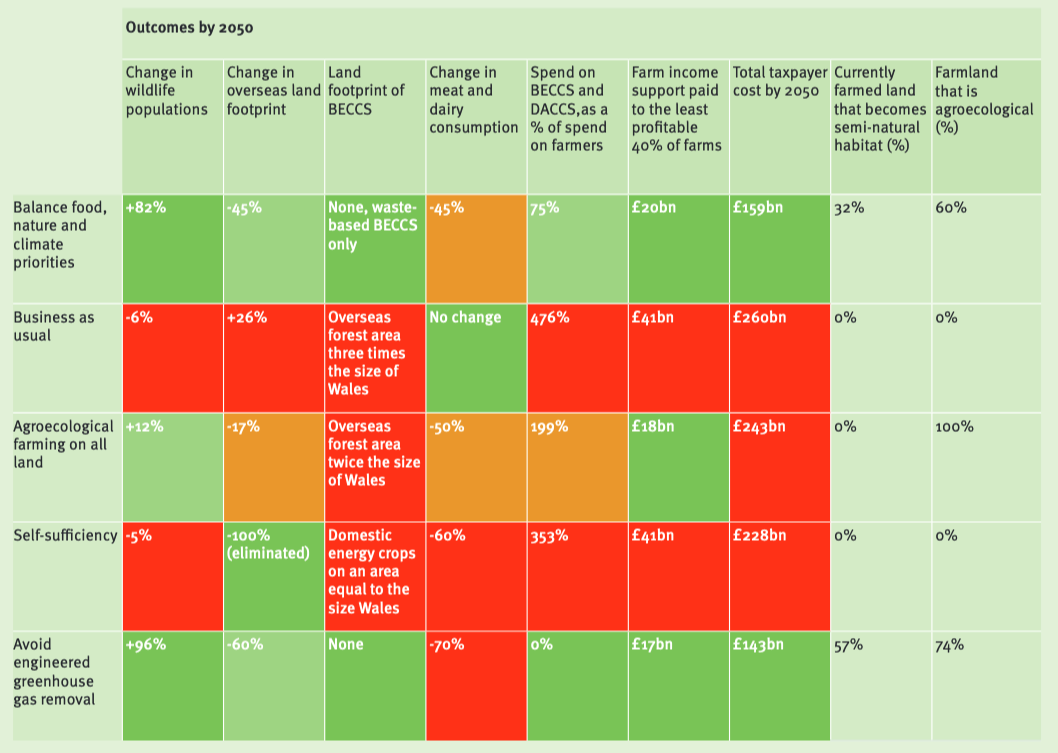
In this report, we model five land use scenarios that restore nature, achieve net zero carbon emissions and
provide good food, each prioritising different goals:
- Balance food, nature and climate action (our recommendation)
- Business as usual
- Agroecological food production on all land
- Self-sufficiency
- Avoid engineered greenhouse gas removal
relying on engineered greenhouse gas removals to offset high residual emissions from farming, instead of restoring habitats that also sequester carbon, would add £100 billion to the cost of net zero to the taxpayer by 2050.
By contrast, funding farmers to manage land for nature and the climate would make most of them better off and cost the taxpayer 1.6 times less overall
Their recommended scenario
Reducing meat and dairy consumption makes achieving other farming goals easier, including raising farm incomes, restoring nature, carbon sequestration, limiting taxpayer costs and increasing self-sufficiency. In our recommended scenario, Meat consumption falls by 45 per cent by 2050, with most processed meat and dairy
(half the UK’s total meat and dairy consumption) replaced with alternative proteins. most processed meat and dairy, which make up half the UK’s consumption, are replaced by alternative proteins. In this scenario, unprocessed meat like a Sunday roast would come from high welfare UK livestock, but most processed meat, like burgers, would be plant-based, but taste like beef.
High yield farming is retained on land best suited to food production, cutting UK dependence on imported produce by half.
Our third insight is that payments for wildlife friendly farming are a cost effective way to increase populations of farm-adapted species and grow food on the same areas of land. In our recommended scenario, wildlife friendly, agroecological farming would expand by a factor of 20 to include most farmed land.
In our recommended balanced priorities scenario, 62 per cent of farmers would receive a greater financial return than they do now, despite farm income support subsidies being replaced by ‘public money for public goods’ transactions. In this scenario, farmers are paid to create enough well managed native woodland, restored peatland and habitats like extensively grazed heath, scrub and acid grassland
Incomes increase for 62 per cent of farms. Taxpayer costs £158 billion to 2050. By 2030, ten per cent of
currently farmed land becomes semi-natural habitat, helping to meet the government’s ‘30x30’ nature goal.20 By 2050, this rises to a third of currently farmed land.
Other Scenarios
- Business as usual
- Replacing all current farming with agroecological methods
- Interestingly, this results in very little biodiversity gain because its so much worse than forests
- It results in a much larger required meat and dairy reduction of 50%
- Becoming totally self sufficient
- 60% meat and dairy decrease required, 12% land converted to bio energy, billions in propping up shitty farms, wildlife declines cannot be stopped.
- Avoiding all carbon capture:
- 70% decrease in meat and dairy consumption
- wildlife doubles, overseas land use falls 60% half of farms become semi-natural, 2/3 of farming is wildlife friendly, agro-ecoological or organic
Other notes
They find that its far better to keep high yield farmland as it is, and converting low yield to forest and wildlife habitats is much better than flat application of agro-ecological farming to everywhere.
They use a "3 compartment" framework:
- semi-natural habitat
- low yield farmland
- Bottom 20% of farmland produces just 3% of food
- high yield farmland
- 40% best farmland produces 2/3 of food
This means the 40% mid-yield farmland produces 30% of food.
- Farms on highly productive land do not usually require subsidy to be profitable. Despite this, they have been receiving 40 per cent of the per area payments under CAP.
- Public money for public goods payments could help farmers on less productive farmland to continue making a living by combining incomes from agriculture and nature restoration
- But if it can't support farmland can it support nature?
A bit of nature goes a long way
- A hectare of woodland supports three to six times more wildlife than farmland and two to four times more wildlife than low yield farmland.
- A hectare of wetland delivers four to seven times more wildlife than a typical farm and three to four times more than low yield farmland
Changing land use on farms in Less Favoured Areas
In 2020-21, a 126 hectare farm in a Less Favoured Area (LFA) lost an average £4,900 a year from farming (not including unpaid labour). With unconditional subsidy, it had a return of £24,400.12 Farms like this could improve their financial returns under reformed policy if they focused on farming carbon and nature, rather than food. we assume the upfront costs of woodland planting continue to be covered by the Woodland Creation Grant Scheme, and that farmers and land managers are paid at a rate that increases their financial return by 20 per cent, even without basic payments. That means this farm would be paid £232 per hectare a year to manage woodland for nature and carbon outcomes. Doing so would increase the farmer’s return by 20 per cent to £29,280 a year and is compatible with low levels of livestock
Their Model
- We model payments to farmers for semi-natural habitat creation, such that their financial return is 20 per cent higher on every hectare managed for environmental outcomes compared to today. This will make semi-natural habitat creation an attractive business prospect.
- we at least maintain current incomes of the lowest earning 40 per cent of farms which would be insolvent without the CAP Basic Payment Scheme
- In assessing their effect on nature, we estimate the average change in population size across 116 UK wild bird species