Schwingshackl et al., 2017a
- Neuenschwander et al., 2023
- health effects of dairy
- Red and processed meat are bad for you
- Health effects of eggs
Schwingshackl, L., Schwedhelm, C., Hoffmann, G., Lampousi, A. M., Knüppel, S., Iqbal, K., ... & Boeing, H. (2017). Food groups and risk of all-cause mortality: a systematic review and meta-analysis of prospective studies. The American journal of clinical nutrition, 105(6), 1462-1473.
Background: Suboptimal diet is one of the most important factors in preventing early death and disability worldwide.
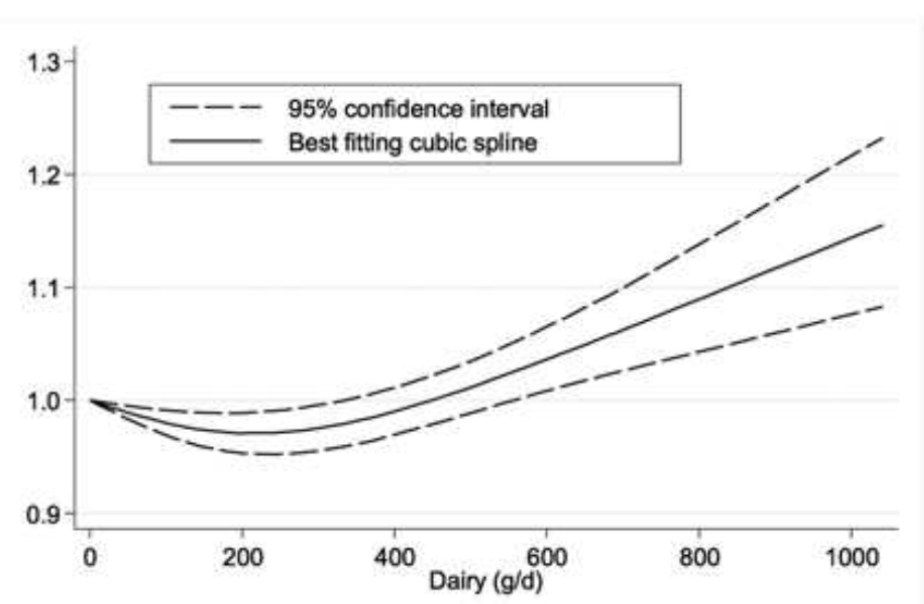
Objective: The aim of this meta-analysis was to synthesize the knowledge about the relation between intake of 12 major food groups, including whole grains, refined grains, vegetables, fruits, nuts, legumes, eggs, dairy, fish, red meat, processed meat, and sugar-sweetened beverages, with risk of all-cause mortality.
Design: We conducted a systematic search in PubMed, Embase, and Google Scholar for prospective studies investigating the association between these 12 food groups and risk of all-cause mortality. Summary relative risks (RRs) and 95% CIs were estimated with the use of a random effects model for high-intake compared with low-intake categories, as well as for linear and nonlinear relations. Moreover, the risk reduction potential of foods was calculated by multiplying the RR by optimal intake values (serving category with the strongest association) for risk-reducing foods or risk-increasing foods, respectively.
Results
One more daily serving of these foods decreases all-cause mortality
whole grains (RR: 0.92; 95% CI: 0.89, 0.95),
vegetables (RR: 0.96; 95% CI: 0.95, 0.98),
fruits (RR: 0.94; 95% CI: 0.92, 0.97),
nuts (RR: 0.76; 95% CI: 0.69, 0.84), and
fish (RR: 0.93; 95% CI: 0.88, 0.98),
One more daily serving of these foods increases all-cause mortality
red meat (RR: 1.10; 95% CI: 1.04, 1.18) and
processed meat (RR: 1.23; 95% CI: 1.12, 1.36)
In a linear dose-response meta-analysis.
A clear indication of nonlinearity was seen for the relations between vegetables, fruits, nuts, and dairy and all-cause mortality. Optimal consumption of risk-decreasing foods results in a 56% reduction of all-cause mortality, whereas consumption of risk-increasing foods is associated with a 2-fold increased risk of all-cause mortality.
Conclusion: Selecting specific optimal intakes of the investigated food groups can lead to a considerable change in the risk of premature death.
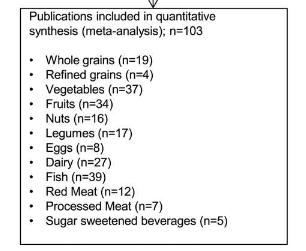
Eggs (all cause mortality)
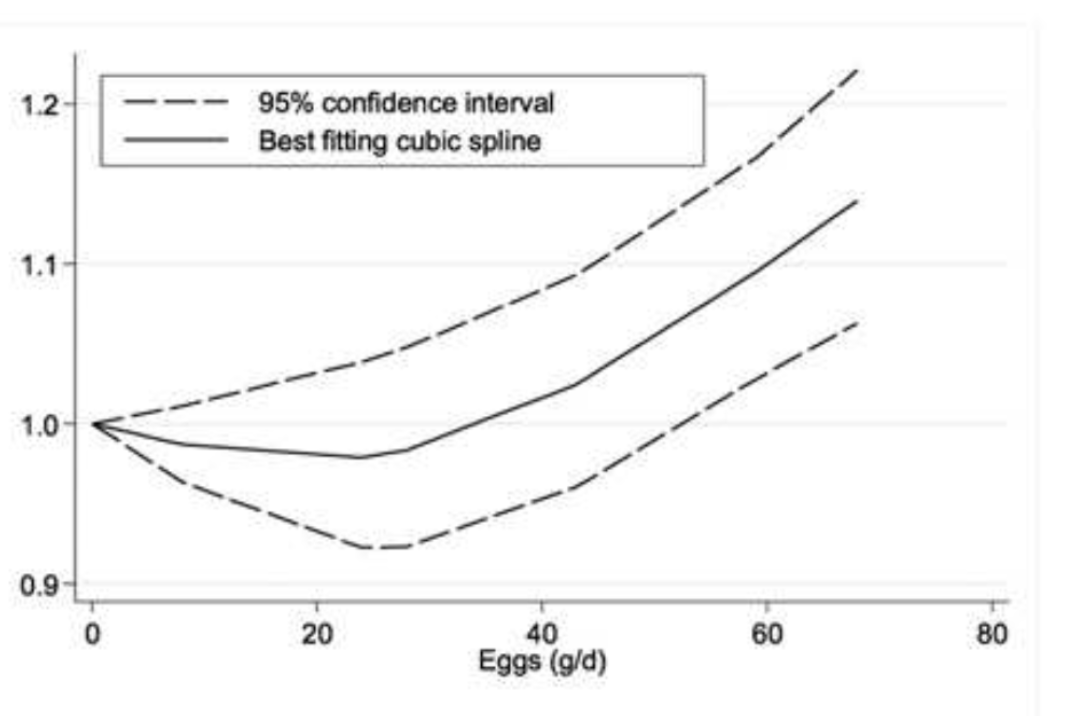
Dairy (all cause mortality)
126,759 mortality cases