Ritchie, 2021
https://ourworldindata.org/soy
Hannah Ritchie (2021) - “Is our appetite for soy driving deforestation in the Amazon?” Published online at OurWorldInData.org.
Summary
- Global soy production has increased more than 10-fold over the past 50 years.
- This has been driven by increased demand for meat – three-quarters of global soy is fed to livestock – and to a lesser extent, soybean oil and biofuels.
- The United States and Brazil each account for more than one-third of global production.
- More and more land has been devoted to soy production. For years this came at the cost of rainforest in the Amazon until 2006 when Brazil introduced a ‘Soy Moratorium’ which stipulated that farmers who grew soy on illegal or legal deforestation areas would not be able to sell them to suppliers. This was a success: deforestation for soy in the Brazilian Amazon declined rapidly.
- Over one-third (37%) of global soy is fed to chickens and other poultry, one-fifth to pigs, and 6% to aquaculture. Very little soy is used for beef and dairy production – only 2%.
- Unfortunately soy production was displaced to other areas where forests are at risk: to tackle this, zero-deforestation policies need to be extended beyond the Amazon region, and the indirect impacts of soy need to be traced more closely.
Has a great interactive graph and data on growth of soy production:
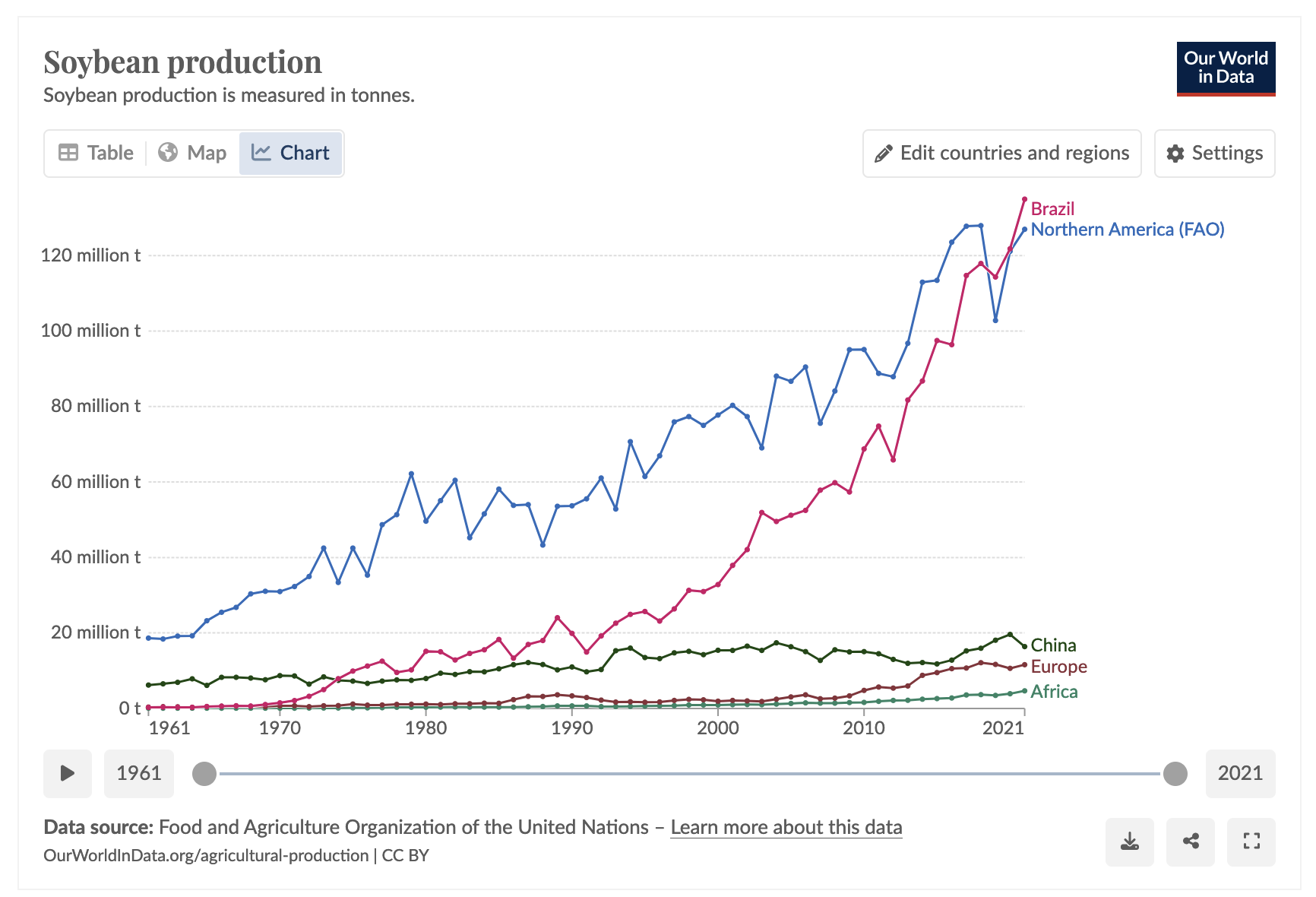
The US and Brazil each account for a 3rd of world soy production, argentina a distant third at 11%.
This data is sourced from an analysis published by the University of Oxford’s Food Climate Research Network (FCRN), which relies on the USDA’s PSD database.3
Over one-third (37%) of global soy is fed to chickens and other poultry; one-fifth to pigs; and 6% for aquaculture. Very little soy is used for beef and dairy production – only 2%.