Mottet et al., 2017
Mottet, A., De Haan, C., Falcucci, A., Tempio, G., Opio, C., & Gerber, P.(2017). Livestock: On our plates or eating at our table? A new analysis of the feed/food debate. Global Food Security,14,1–8.https://doi.org/10.1016/j.gfs.2017.01.001
https://www.sciencedirect.com/science/article/abs/pii/S2211912416300013
- 86% of the global livestock feed intake in dry matter consists of feed materials that are not currently edible for humans
- Contrary to commonly cited figures, 1 kg of meat requires 2.8 kg of human-edible feed for ruminants and 3.2 for monogastrics
- Livestock consume one third of global cereal production and uses about 40% of global arable land
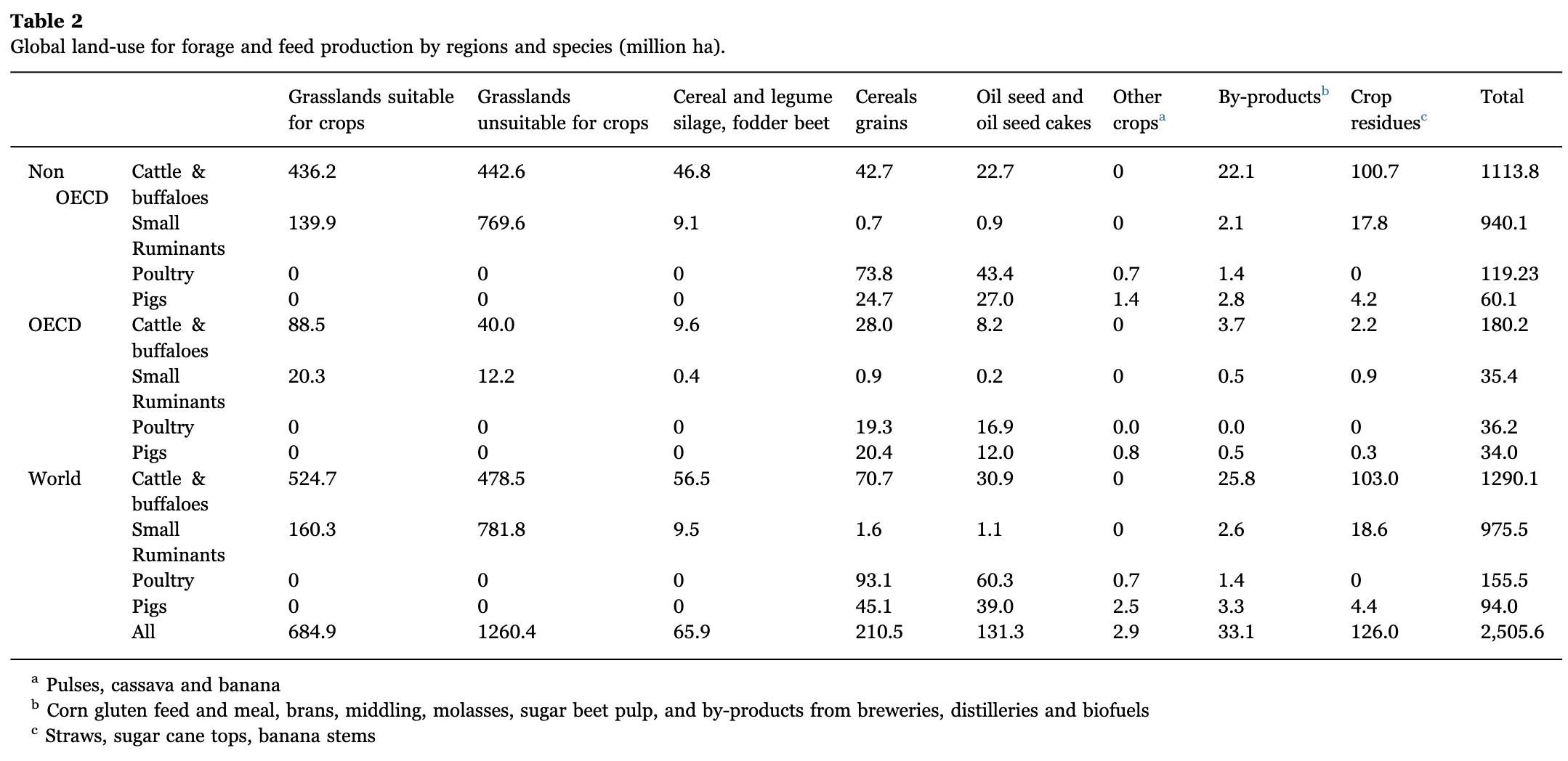
- Livestock use 2 billion ha of grasslands, of which about 700 million could be used as cropland
- Modest improvements in feed conversion ratios can prevent further expansion of arable land dedicated to feed production.
- At global level, human-edible feed materials represented about 14% of the global livestock feed ration. Grains made up only 13% of the ration, but represented 32% of global grain production in 2010
Livestock contribute to food security by supplying essential macro- and micro-nutrients, providing manure and draught power, and generating income. But they also consume food edible by humans and graze on pastures that could be used for crop production. Livestock, especially ruminants, are often seen as poor converters of feed into food products. This paper analyses global livestock feed rations and feed conversion ratios, with specific insight on the diversity in production systems and feed materials. Results estimate that livestock consume 6 billion tonnes of feed (dry matter) annually – including one third of global cereal production – of which 86% is made of materials that are currently not eaten by humans. In addition, soybean cakes, which production can be considered as main driver or land-use, represent 4% of the global livestock feed intake. Producing 1 kg of boneless meat requires an average of 2.8 kg human-edible feed in ruminant systems and 3.2 kg in monogastric systems. While livestock is estimated to use 2.5 billion ha of land, modest improvements in feed use efficiency can reduce further expansion.
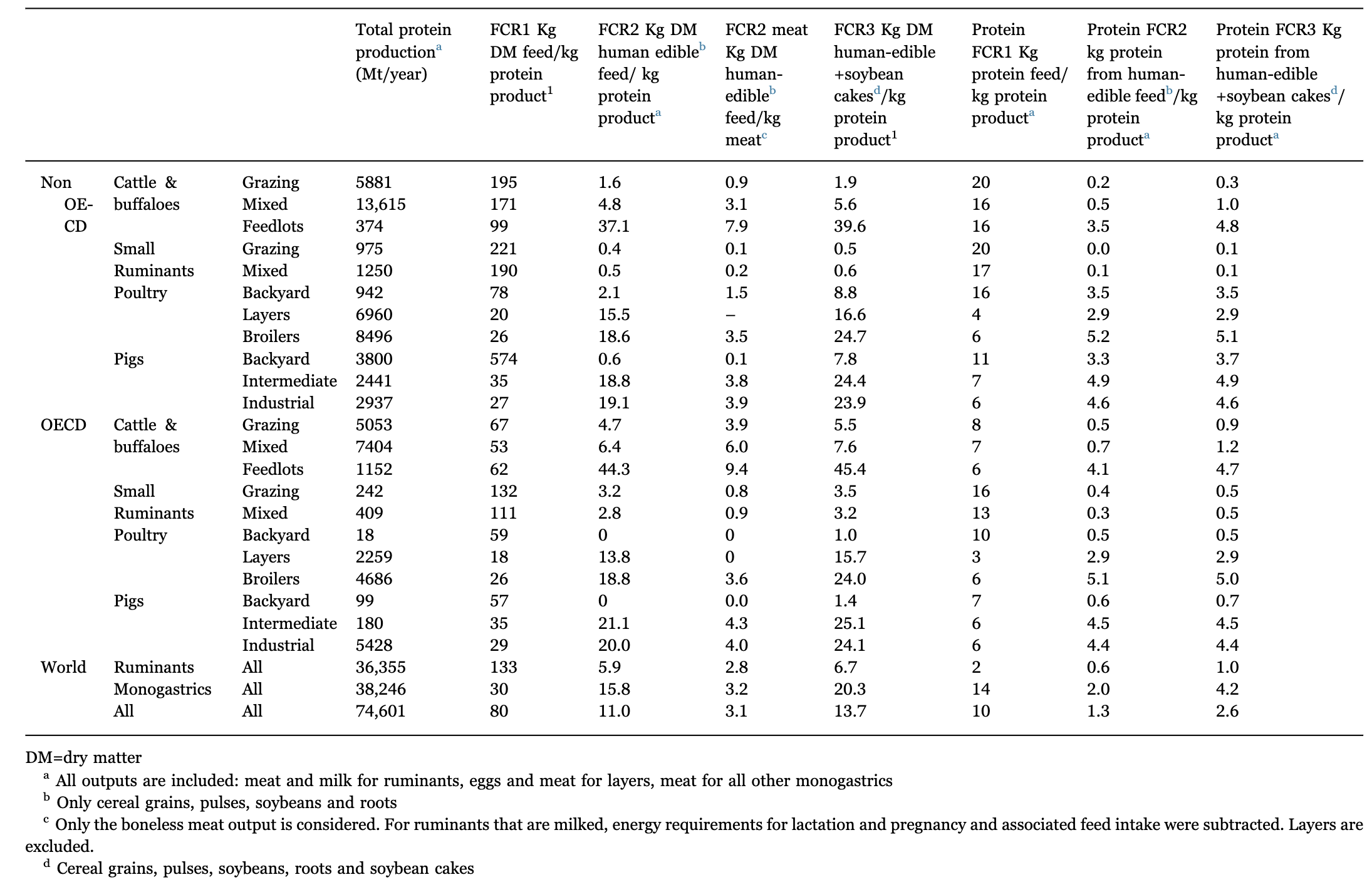
When considering only feed materials that are edible by humans (FCR2), at global level, ruminants use 5.9 kg of human-edible feed/kg of protein whereas monogastrics need 15.8 kg. The highest ratio, however, is found in cattle feedlots: 44.3 kg in OECD countries and 37.1 kg in non-OECD countries. It is also relatively high in industrial pigs, layers and broilers, ranging from 13.8 to 20.0 kg. At the other end of the scale, the lowest FCR2 are found in backyard monogastric systems and in grazing and mixed (crop/livestock) ruminant production.
Grazing systems in non-OECD countries and backyard monogastric systems appear to have poor protein-use efficiency (20 kg and 16 kg and 11 kg protein feed /kg protein product respectively), because of the overall low productivity in those systems. They do, however, require relatively little human-edible protein.
Protein production and feed conversion ratios by regions, species and production system
My notes
- When a crop was used for food, it was only classified as in competition with human food if the "economic fraction allocation" was 66% or higher (only the case for soybean cake). If it is < 66%, the feed material is not considered as the main driver of land-use.
- Interestingly it takes 195kg of grazing feed to produce 1 kg of beef, but only 1.6kg is edible.
- Backyard pigs product 1kg of meat for only 0.6kg of human edible product, so are quite efficient, backyard poultry do not compete at all for human food.
- 57% of the land used for feed production is not suitable for food production.
- Very low efficiencies in terms of overall feed input can be found in extensive grazing ruminant systems due not only to low productivity but also to low nutritional density of feed. But when expressed in terms of human-edible protein, those systems are efficient converters of vegetal protein into animal protein, better than industrial monogastric systems that consume less feed but larger amounts of human-edible feed and soybean cakes per unit of product.