Malan et al., 2022
The strongest evidence of actual behavioral impacts of PTC-equivalent plant-based meats likely comes from a study introducing Impossible Foods’ plant-based ground beef to a University of California Los Angeles dining hall (Malan et al., 2022). Impossible ground beef was introduced at two stations in the dining hall. On Thursdays, students had the option of receiving prepared burritos with either Impossible ground beef, animal-based steak, or veggies, while the build-your-own entree line offered Impossible ground beef every day alongside animal-based ground beef.
In this study, price is entirely equivalent since students pay for dining hall access for the entire semester, not individual meals. With regards to taste, Impossible ground beef specifically has not been subjected to any public taste tests. However, as reviewed above, the Impossible Burger, which is made of similar ingredients, has been found to taste equivalent in some studies. The study does not describe exactly the form of the beef in the steak burrito, making its taste equivalence less certain but probably still a reasonable inference. For the ground beef served on the build-your-own entree line, taste equivalence seems very likely.
Convenience is likely equivalent as well since the burritos are prepared for students by dining hall staff, and the build-your-own entree line is self-serve for both animal- and plant-based ground beef. The study measured how many beef-containing meals were distributed at the intervention dining hall, where the Impossible ground beef was available, as well as distribution at two other dining halls as controls, which we refer to as A and B. For all dining halls, data on how many meals of each type were served was available before and after the intervention. Dining halls were not randomized to intervention and control status, and participants were free to cross over between dining halls during the study, both factors that could bias effects in either direction. Control dining hall A was adjacent to the intervention dining hall, so intervention materials were potentially visible, while control dining hall B was isolated from the intervention. In addition to making plant-based meat available, the study employed several co-interventions designed to reduce meat consumption (Malan, 2020). These included environmental education, low carbon footprint labels on menus, and an advertising campaign to promote the new product, all of which have some evidence demonstrating their effectiveness (Bianchi, Dorsel, et al., 2018, p. 11; Brunner et al., 2018; Jalil et al., 2019; Osman & Thornton, 2019). Thus, the study’s results cannot be entirely attributed to the addition of plant-based meat options to the intervention dining hall’s menu.
To begin, we focus only on the burrito station of the intervention dining hall. In the ten weeks after adding the Impossible burrito to the intervention dining hall’s menu, 26% of burrito purchasers chose the Impossible, 7% the veggie, and the remaining 67% the steak burrito (Malan, 2020, Table 12). Consistent with previous results, in a scenario that ensures price, convenience, and potentially taste competitiveness, the portion of consumers selecting the plant-based meat option remains modest.
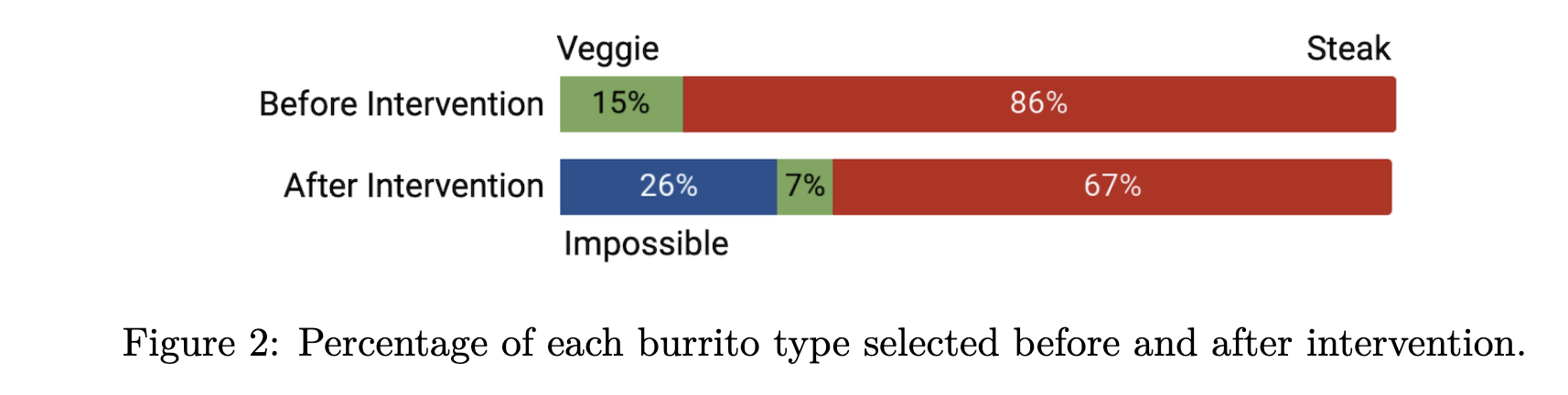
The before and after, as well as control, data available in this study also demonstrate crucial shortcomings in the HDCEs and commercial case studies: they do not compare against a counterfactual where plant-based meat is unavailable. Thus, it is unclear what would have happened otherwise, which is crucial for understanding the causal effect of plant-based meat on animal-based meat usage. One approach to estimate the outcome of such a counterfactual scenario is to use the before-intervention data in Figure 2, which shows the veggie burrito comprises 15% of selections in the absence of the Impossible burrito. With the Impossible burrito available, this share declines to 7%, suggesting the Impossible burrito partially replaced the demand for veggie burritos rather than animal-based beef. Thus while 26% of burritos distributed were Impossible burritos, using the before-intervention data suggests only a 19 percentage point decline in steak burritos.
The control dining halls in the study provide a more rigorous approach to estimating a counterfactual than the before and after analysis. However, to make the control and intervention dining halls comparable, we must expand our focus to all Impossible ground beef meals, not just burritos. Since Impossible ground beef is designed to be a substitute for animal-based beef, we expand our analysis to all animal-based beef meals (rather than just steak burritos) but exclude impacts on other meats like poultry or pork. For comparison’s sake, we can repeat the analysis in Figure 2 using this new outcome measure (Figure 3). As before, we first consider a naive analysis that assumes every Impossible ground beef entree displaced an animal-based beef entree. Since 11.4% of entrees in the intervention dining hall were Impossible ground beef, we would assert an 11.4 percentage point reduction in beef entrees. Next, we look at actual beef demand before and after adding Impossible ground beef to the intervention dining hall and find a much smaller decline of 3.3 percentage points.
To compare the intervention and control dining halls, we will compute a difference in differences we will first compute changes in the proportion of beef entrees distributed before and after intervention in each dining hall. Second, we take the difference of the before-and-after changes between the intervention and control dining halls.7 When comparing the intervention dining hall against control dining hall A—where the percentage of beef entrees actually increased—the effect of Impossible ground beef looks somewhat better, resulting in a 4.0 percentage point decrease in beef entrees. Conversely, beef demand went down in control dining hall B, so the estimated effect of Impossible ground beef looks somewhat smaller at 2.1 percentage points. Lastly, comparison to both control sites combined yields an effect in between the others, a 3.2 percentage point decline. While these are small numbers, the relative effect of different approaches to estimating a counterfactual is large, which underscores the importance of appropriately measuring what would have happened otherwise.
Nonetheless, this variation in the control dining halls is surprising: after all, in the absence of intervention, we might expect no change. In this case, the prominent launch of Impossible ground beef at the intervention dining hall may have affected which of the three dining halls the students chose. Looking at the change in the number of entrees distributed at each dining hall suggests one possible story of spillover. Control dining hall A, which was adjacent to the intervention dining hall, saw a 12,432 entree decline in overall meals distributed, a 2.4 percentage point decline in demand for other vegetarian options (besides Impossible ground beef), and a 0.7 percentage point increase in beef entree demand. Meanwhile, the intervention dining hall saw a 16,529 meal increase. Together this points to the possibility that the intervention, in fact, concentrated students likely to eat Impossible ground beef at the intervention dining hall while encouraging beef-eating students to go next door, without having much effect on total consumption. Control dining hall B, which was further away, also saw an 8,775 entree decline in the overall number of meals distributed. However, this control saw a small increase (1.1 percentage points) in demand for other vegetarian options and a small decrease (1.2) in beef demand, opposite of the changes at control dining hall A.
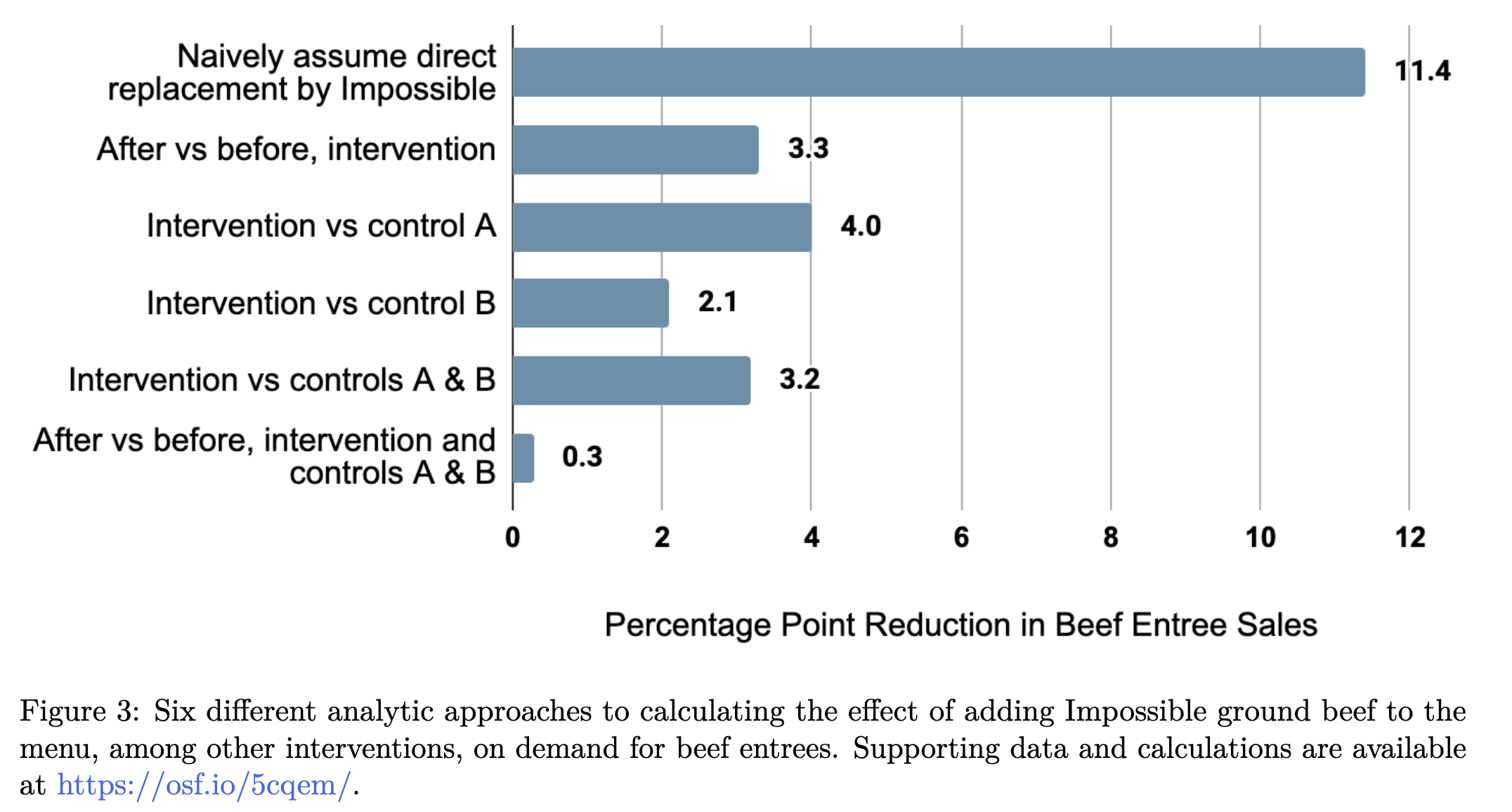
One way to account for this potential spillover of students between intervention and control is to simply ignore the distinction between intervention and control sites. Instead, the study sites can be combined in a single before and after analysis. This yields a very small change in beef entree selection, only 0.3 percentage points, compared to a 5.0 percentage point increase in Impossible ground beef entree selection. There was also a 2.6 percentage point decline in other vegetarian selections. This analysis supports the idea that introducing Impossible ground beef may have primarily attracted students already willing to eat vegetarian entrees from other dining halls. While Malan (2020) is not straightforward to interpret, it illustrates the importance of making comparisons to counterfactual scenarios and demonstrates that only a small share of consumers might prefer PTC-competitive plant-based meat.