Institute for Sustainable Futures, 2022
Reported here: https://www.uts.edu.au/news/social-justice-sustainability/widespread-confusion-over-meat-free-food-labels-unfounde
Summary here: https://www.uts.edu.au/sites/default/files/2022-03/Summary report - Consumer perceptions of food labels in Australia.pdf
The Institute for Sustainable Futures at the University of Technology Sydney (UTS)
Representative sample of 1014 Australians. Asked about their experience with and perceptions of plant-based foods. Questions posed included the presentation of images of currently available supermarket products and whether the respondent thought they were: a plant-based meat product, an animal-based meat product, or whether they were undecided/unsure.
Incorrect choices are highly unlikely to occur as a result of misleading labelling, and that increased exposure to plant-based meat substitutes and their labels reduces the risk of incorrect choices even further. The survey results also indicated that many consumers are keen to eat more plant-based products, but that the incidence of consumer confusion in this product category is significantly higher than when seeking meat-based products.
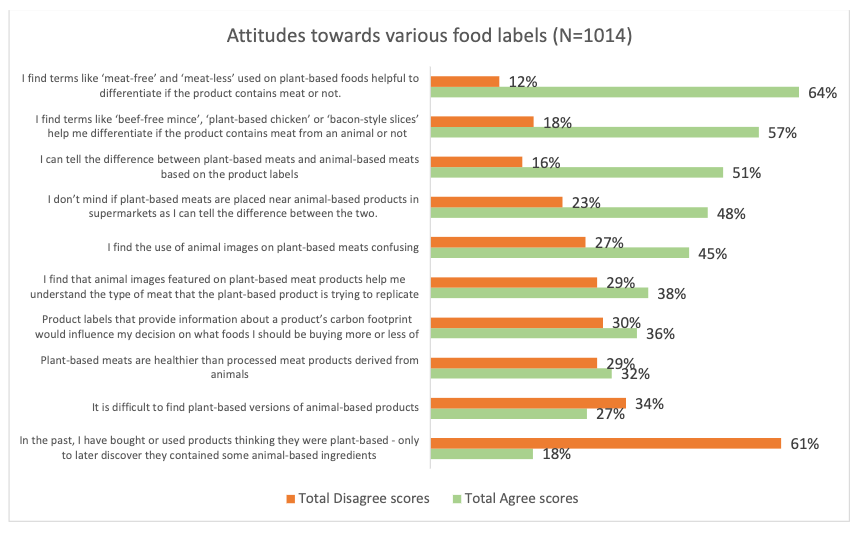
- There is no widespread confusion among Australian consumers. Only 4% of people surveyed inadvertently purchased a plant-based product because of confusion with labels. Of those respondents who purchased plant-based products believing them to be animal products, 67% indicated this was because they were in a hurry or distracted and did not read the product label.
- Plant-based consumers are far more likely to buy a product in error than the other way around, with 41% of plant-based respondents having bought a product to later discover it contains animal ingredients.
- 64% of respondents find generic terms like ‘meat-free’ and ‘meat-less’ helpful to differentiate if products contain meat or not, and 57% find specific terms like ‘beef-free’, ‘plant-based chicken’, and ‘bacon-style’ helpful to know if products contain meat or not.
- 22% of respondents indicated they want to eat more plant-based foods, and reduce the amount of animal products they consume, and
- 26% of respondents indicated they are likely to substitute a plant-based product for an animal product in the next 12 months.