Blackmore et al 2018
https://www.tandfonline.com/doi/abs/10.1080/19439342.2018.1452777
Blackmore, I., Lesorogol, C., & Iannotti, L. (2018). Small livestock and aquaculture programming impacts on household livelihood security: a systematic narrative review. Journal of Development Effectiveness, 10(2), 197-248.
Main message: A systematic review concluded that there is only weak evidence that giving poor people small livestock (goats/chickens) or fish is effective in improving their lives. We haven't got great evidence either way.
Nearly 60 per cent of the studies that met the review’s inclusion criteria were exploratory, meaning that there simply isn't very strong evidence that small scale farming is beneficial.
- Some evidence that small livestock and fish have had significant impacts on income. Some studies did not find that giving families poultry increased their income, because chickens were kept for special occasions or used as an asset to sell in an emergency.
- Most nutrition focused interventions did not significantly reduce the prevalence of stunting, underweight, or wasting in children. Only 1 of the 12 nutrition studies significantly reduced stunting.
- A common theme of the studies is that whilst the interventions were generally successful on surface metrics (participants increased goat herds/chicken flocks over time, families reported eating more ASFs), they often did not translate into improvements in metrics we care about (families did not increase their income or improve their children's health).
- With fish, a lot of the time participants could not fully realise the value because they either had to grow fish in communal ponds/rivers or because they lacked training/infrastructure to raise and sell them properly.
- Nutrition-focused interventions do appear to significantly improve dietary diversity.
- Based on the four studies that examined women’s empowerment, small livestock and fish interventions do not appear to have sustained positive impacts on women’s empowerment.
Methods
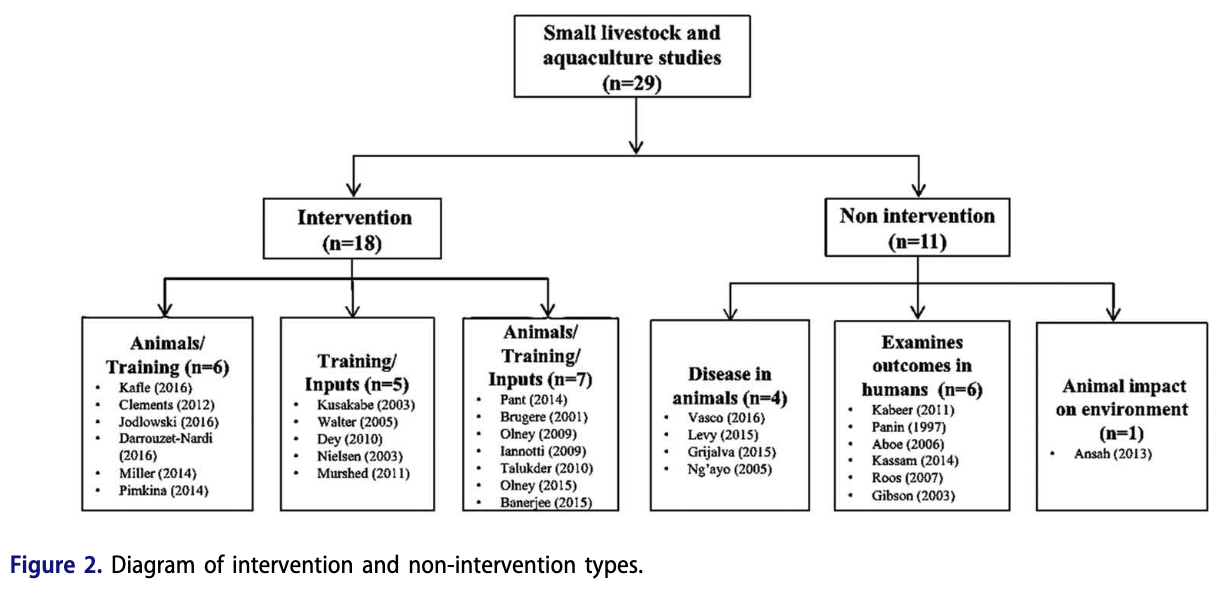
The majority of studies were interventions or attempted to evaluate interventions conducted by a third party.
A third delivered animals and training, another third solely training and inputs, and the final third provided animals, training, and inputs. The type of animal provided was typically goats or poultry, training centred on animal husbandry, and inputs included microcredit, consumption support, fish nets, and materials to build structure to keep the livestock/fish.