Anderson and Tyler, 2018
https://faunalytics.org/wp-content/uploads/2018/09/BRIC-Full-Report.pdf
An exploratory study of attitudinal and behavioral differences among people in the “BRIC” countries –
Brazil, Russia, India, and China – plus the United States.
Key findings
- Most people want better welfare for animals, regardless of country: The majority of people in the BRIC countries and the U.S. said they would support a law requiring the humane treatment of animals used for food.
- Despite wanting better welfare for farmed animals, most people don’t believe their meat-eating is to blame for animal suffering: About half of respondents from Brazil and India believed that eating meat directly contributes to animal suffering, and a third or fewer from Russia, China, and the U.S. did.
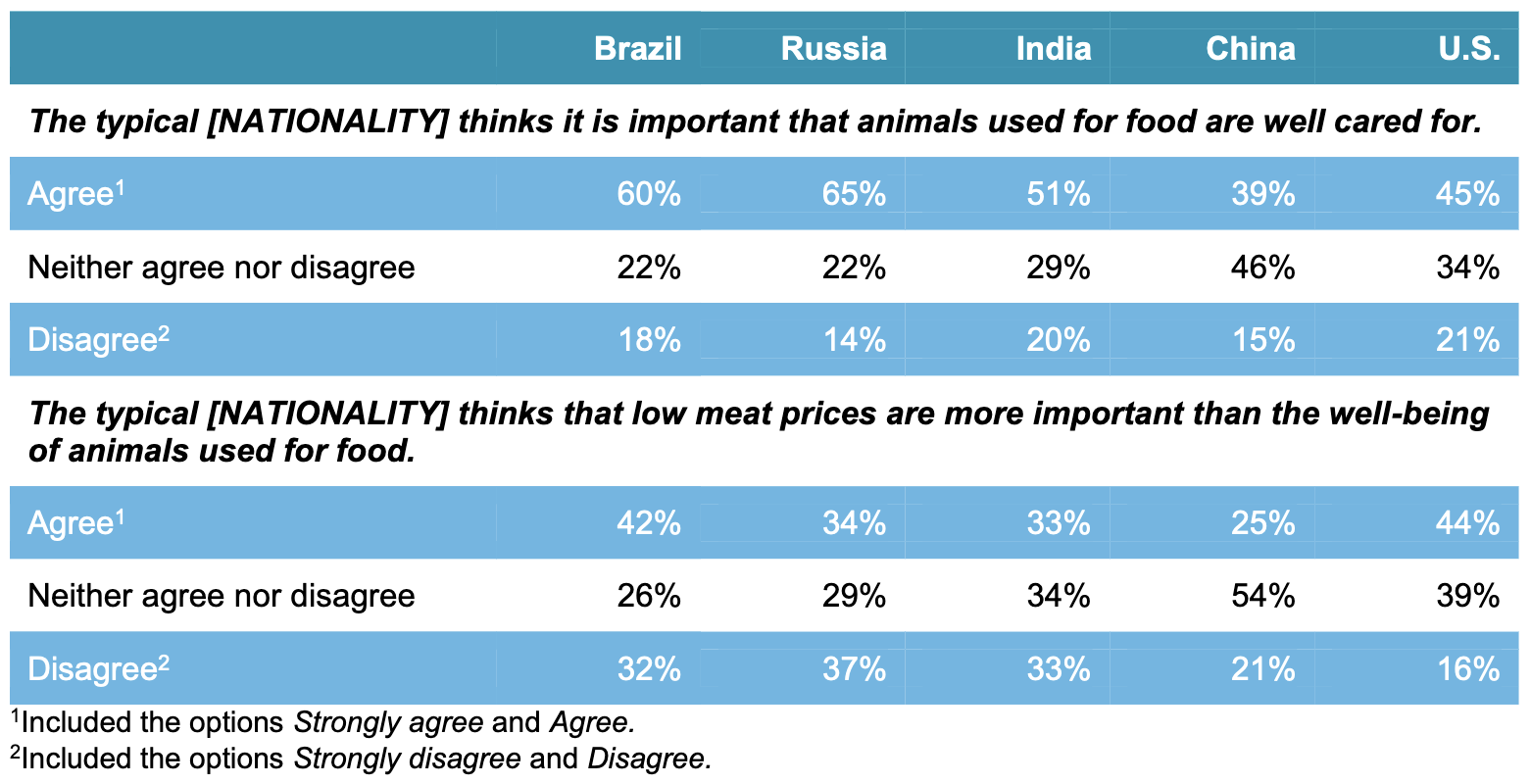
- Brazilians have the most pro-animal attitudes: Respondents from Brazil were the most likely to say that the care and well-being of farmed animals are important, and tended to be among the more pro-animal across the survey. Respondents from Russia and the U.S. tended to fall in the middle of the range, with India and China at the bottom.
- People assume that other people are less pro-animal than they are: In all countries, the percentage of people who agreed that it is important for farmed animals to be well cared for was higher than the percentage who thought that a typical citizen of their country would agree that it’s important. Social norms are a powerful force, so this finding suggests that there is room to increase public support for animal advocacy in all five of these countries by informing people that others also think animal welfare is important.
- More people are reducing than increasing their meat consumption: Most survey respondents said they were eating the same amount of meat as usual. However, of the rest, a reduction was somewhat more common than an increase. The extent of the difference varied from country to country and was largest in the U.S., India, and Russia.
- From an interpretive standpoint, it is important to note that people from China did not express many strong opinions. Thus, consistently lower levels of agreement or support from Chinese respondents does not necessarily indicate anti-animal sentiment—they also did not tend to disagree or oppose. Chinese respondents may not have strong feelings on animal issues, or may prefer not to express their opinions.
Methods
about 1000 people from each country, roughly representative but some were less representative.