Animal agriculture takes up lots of land but provide few calories
- The inefficiency of animal products
- Feed-food competition
- Is pastoralism the solution to the problems food security and animal agriculture
- Animal agriculture drives deforestation
The land used to grow crops for people to consume directly (i.e. plant-based food) supplies more calories and protein for the global population than the almost 4-times larger area used for animal agriculture (Our World in Data).
If we combine global grazing land with the amount of cropland used for animal feed, livestock accounts for 80% of agricultural land use. The vast majority of the world’s agricultural land is used to raise livestock for meat and dairy. (Ritchie and Roser, 2019, updated 2024 ).
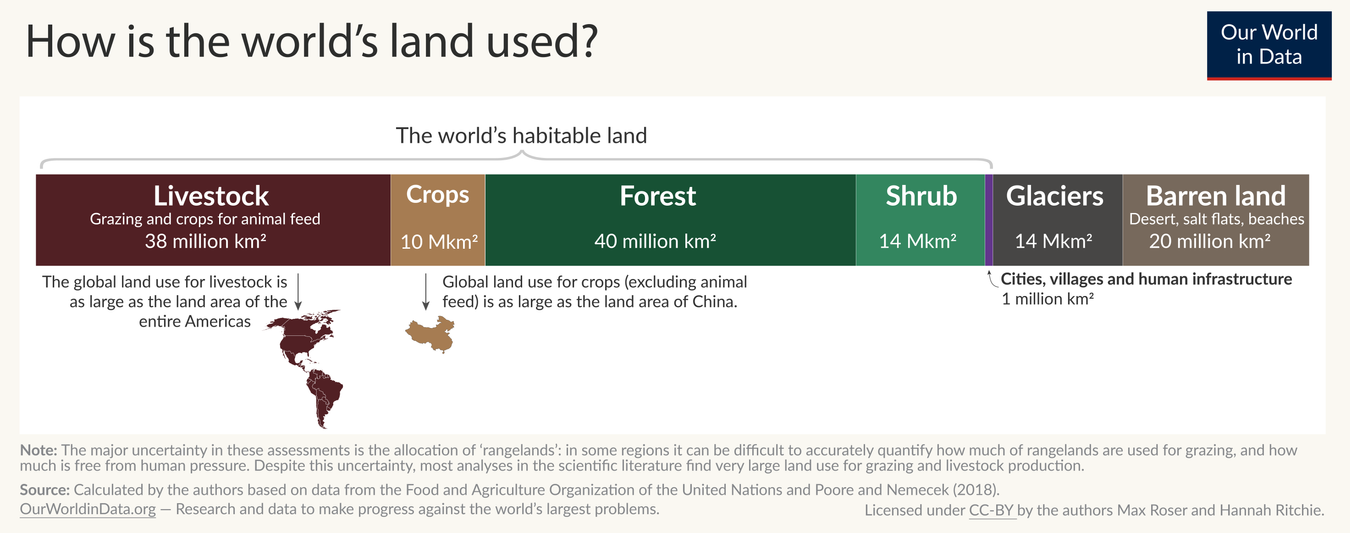
- Without meat and dairy consumption, global farmland use could be reduced by more than 75% – an area equivalent to the US, China, European Union and Australia combined – and still feed the world (Poore and Nemecek 2018).
- Research published in Climactic Change found that substituting beans for beef alone would free up 42% of US cropland[1]
- Extending the current diet of wealthy industrialized countries (OECD) to the current global population would require an additional 35 million km2 to support livestock production - an area roughly equal to the combined area of Africa and Australia[2]
- About 60% of the world's agricultural land is used for beef, which only accounts for less than 5% of protein and 2% of calories worldwide[3]
- Meat and dairy provide just 18% of calories and 37% of protein, but use 83% of farmland (Poore and Nemecek 2018)
- A study by Peters et al., (2016) finds that in order to reduce overall land usage in the US, meat reduction may need to be as high as 40%. Interestingly they found that vegetarian diets generally supported a large population than vegan ones.
We have reached "peak agricultural land"
Our World in Data have an interesting piece showing that humanity's land use for agriculture actually peaked in the early 2000s and has declined since then. This is despite food production continuing to increase. I find this statement to be very misleading to the point where its probably more harm than good.
This is primarily because most of the growth in meat production has come from pork, poultry and intensively raised beef, which don't take up huge amounts of land. We've been reducing our grazing land, but increasing the land used to grow crops. This is one of the rare areas where factory farming actually does have a benefit over other forms of livestock raising.
It should also be noted that while global agricultural land has peaked, it's rising in many places and falling in more places. See here. Problematically, farmland is increasing in areas that have the most biodiversity and decreasing in areas that have lower biodiversity.
The nuanced picture is this: when we say that animal agriculture uses too much land, we're almost entirely talking about grazing cattle. Factory farmed livestock don't take up huge amounts of land. Given that crop yields improve over time, we might be able to feed the whole world on factory farmed animals without massively increasing our land use. However, it is also true that getting rid of animal farming all together and eating the crops that we normally feed to them is by far the most land efficient use.
Grazing land
The tripling of cattle populations between 1961 and 2016 (FAOSTAT, 2016) led to pastureland expanding 20 in asia and 33% Latin America (FAOSTAT, 2017). Currently over 2/3 thirds of agricultural land is used for grazing, which represents one third of all habitable land on the planet. Most of this is used for beef, , which only accounts for less than 5% of protein and 2% of calories worldwide[3:1].
References
https://www.theatlantic.com/health/archive/2017/08/if-everyone-ate-beans-instead-of-beef/535536/ ↩︎
Eisen, M. B., & Brown, P. O. (2022). Rapid global phaseout of animal agriculture has the potential to stabilize greenhouse gas levels for 30 years and offset 68 percent of CO2 emissions this century. PLoS Climate, 1(2), e0000010. ↩︎
https://www.ucsusa.org/resources/grade-choice#:~:text=Nearly 60 percent of the,kilometers of land to produce ↩︎ ↩︎